$1.7–3.5T
Range of market-size estimates
2.73%
Q1 2026 default rate, up from 1.84%
2.51%
Q2 2026 rate — a partial pullback
$5.4B
Redemptions Blue Owl capped at two funds
KEY TAKEAWAYS
• Private credit defaults rose for two straight quarters, from 1.84% to 2.73%, before easing slightly to 2.51%.
• Serious analysts can’t agree on the size of the market itself — estimates range from $1.7 trillion to $3.5 trillion.
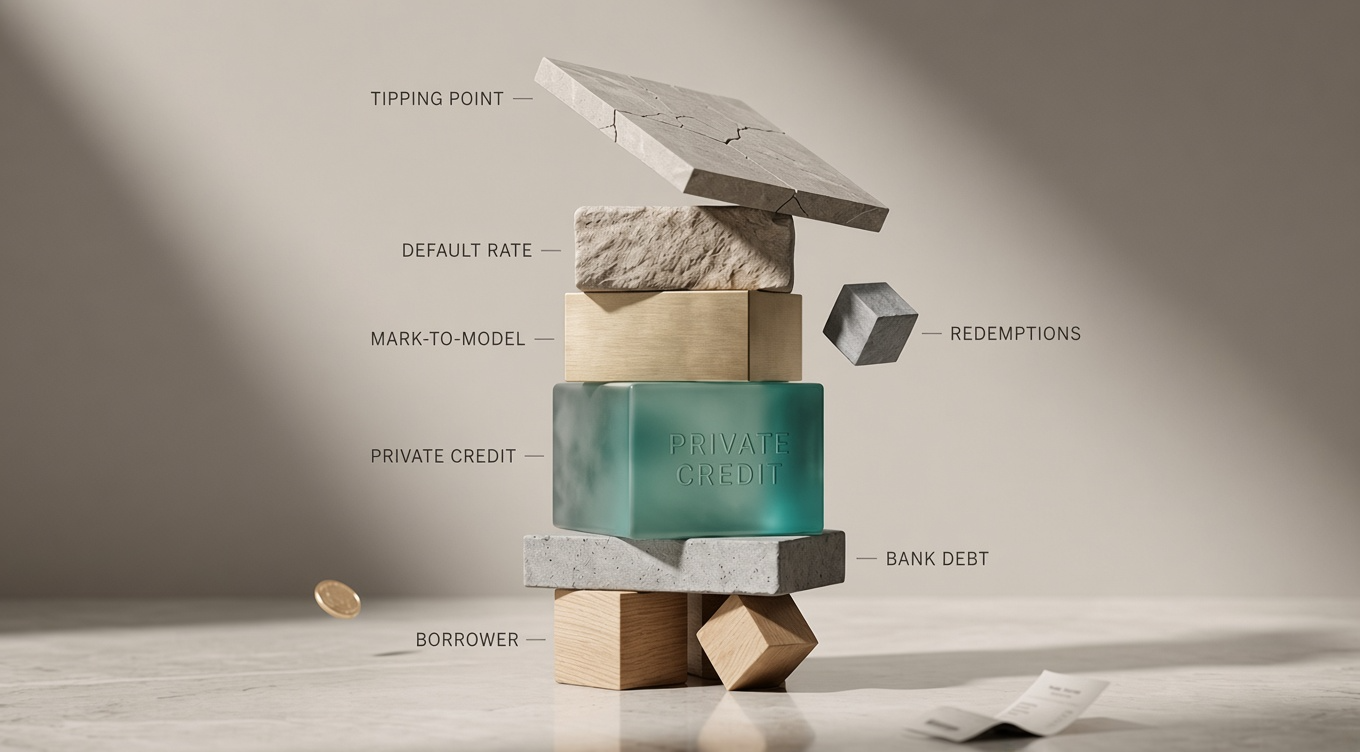
• A private loan’s value is set mainly by the lender that made it, under SEC-mandated procedures — not by continuous trading on an open market.
• JPMorgan’s Jamie Dimon says losses will run “higher than expected” once a real credit downturn hits — while calling the risk to banks non-systemic.
• Blue Owl Capital capped withdrawals at two funds in early 2026 after investors asked for $5.4 billion back, a sign of real stress beneath a calm headline number.
What Private Credit Actually Is
Private credit is a simple idea. A company needs to borrow money. Instead of going to a bank, or selling bonds on the public market, it borrows directly from a specialty lender — often a private equity firm’s lending arm.
That lender then holds the loan, or packages it into a fund that ordinary investors can buy into. These funds are often called BDCs, short for “business development companies.” Think of a BDC as a basket of loans instead of a basket of stocks.
The part that matters for this story: none of this trades on an exchange. There’s no ticker, no daily price, no crowd of buyers and sellers arguing over what a loan is worth. The market is, by design, private.
The Default Number That Moved
Law firm Proskauer runs the closest thing this market has to an official scoreboard: the Private Credit Default Index. It tracks senior, secured loans across the industry.
The index rose two quarters in a row. It stood at 1.84% in the third quarter of 2025. It climbed to 2.46% in the fourth quarter, then to 2.73% in the first quarter of 2026 — the highest reading in the index’s recent history. In the second quarter of 2026, it eased back slightly, to 2.51%.
That is not a crash. It’s a climb, followed by a small step back. But the direction over the past year is clear, and it lines up with a separate warning from the head of the largest bank in America.
Nobody Agrees How Big This Market Is
Before getting to that warning, it’s worth sitting with something odd: analysts can’t agree on how large this market even is.
Depending on which estimate you read, private credit is worth somewhere between $1.7 trillion and $3.5 trillion. Some place it right around $2 trillion. Others, counting more broadly, put it near double that. The gap isn’t a rounding error — it’s roughly the size of the entire U.S. high-yield bond market.
WHY THE SIZE IS SO DISPUTED
Different research firms count different things. Some only count direct loans to mid-sized companies. Others add in asset-backed lending, real estate debt, and “dry powder” — money that’s been raised but not yet lent out. There’s no single regulator that requires everyone to report the same way, so every estimate is really a best guess built from surveys and firm-by-firm disclosures.
If experts can’t agree on the size of the whole pool, that’s a preview of a harder problem: pricing what’s inside it.
How These Loans Actually Get Priced
A public stock or bond is priced by trading. Buyers and sellers meet, a deal happens, and everyone can see the result. A private credit loan doesn’t have that. Instead, its value is set through something called a “mark” — a periodic valuation the lender assigns to its own loan.
That process isn’t a free-for-all. Under SEC rules for these funds, a board of directors is legally responsible for approving how each loan is valued, and most large lenders bring in outside valuation firms to check their numbers before they’re finalized.
The gap is narrower than “no oversight at all,” but it’s still real. A mark is typically set once a quarter, by people chosen and paid by the lender, and reviewed against models and comparable deals — not tested against an actual buyer willing to pay cash today. Public markets get repriced by strangers every few seconds. Private credit gets repriced by insiders every few months.
What Dimon Is Actually Warning About
JPMorgan CEO Jamie Dimon addressed this directly in his April 2026 shareholder letter. His core argument wasn’t that private credit will collapse — he was explicit that he doesn’t see it as a systemic threat to the banking system, given its size relative to the broader financial system. His concern was narrower, and in some ways more specific: that lending standards have quietly loosened, and that losses will be worse than most people currently expect once a real credit downturn arrives.
“Losses on all leveraged lending… will be higher than expected.”
— Jamie Dimon, JPMorgan Chase 2026 shareholder letter
Dimon tied that warning directly to the pricing gap described above. In his letter, he pointed out that private credit doesn’t have the same transparency or rigorous valuation marks as public markets — and argued that this makes investors more likely to panic and pull out if conditions worsen, even when actual underlying losses haven’t moved much at all.
The warning didn’t stay theoretical for long. Days later, Blue Owl Capital — one of the largest private credit managers — capped withdrawals at 5% across two of its funds after investors asked to redeem $5.4 billion, equal to 22% of one fund and 41% of a smaller, tech-focused one. Rival managers Ares, Apollo, and HPS all reported smaller but still elevated redemption requests over the same stretch.
The Case for Staying Calm
None of this means the sector is quietly collapsing. There’s a real counter-case, and it deserves equal weight.
Proskauer’s own researchers describe the trend as “modest” and note that private credit default rates remain lower than those in the broadly syndicated loan market — the more traditional, bank-arranged version of the same kind of lending. Most of these loans are also senior and secured, meaning lenders sit near the front of the line to get repaid if a company does fail.
The Q2 2026 pullback, from 2.73% down to 2.51%, is a real data point too. It suggests the sector isn’t sliding in one direction — it’s bouncing around a level that’s elevated, but not alarming on its own. And Dimon himself, weeks later, said he wasn’t “particularly worried” about the sector posing risk to banks like his.
Ludicarc’s Take
VERDICT
The default rate is not the real story here. A move from 1.84% to 2.73%, followed by a partial pullback, is a normal-looking credit cycle — not a crisis by itself.
The real story is what sits underneath that number. Private credit isn’t unvalued or unregulated — boards approve the marks, outside valuation firms review them, and SEC rules govern the process. But none of that adds up to independent, continuous price discovery. The checks are periodic and firm-led, not constant and market-tested, and even the market’s total size is a matter of dispute among serious analysts.
None of that proves fraud or hidden losses. It points to something narrower: in a market this size, investors are leaning more heavily on process and disclosure, and less on a real-time, independently tested price, than most public-market investors are used to.
SOURCES
• JPMorganChase, 2025 Annual Report — Chairman & CEO Letter to Shareholders (primary source, April 2026)
• Proskauer, Private Credit Default Index, Q1 2026 and Q2 2026 (primary industry data)
• SEC, Rule 2a-5 under the Investment Company Act of 1940 — fair value determination requirements for funds and BDCs, via Willkie Farr & Gallagher summary
• Bisnow, “Blue Owl Caps Redemptions After Investors Sought $5.4B Across 2 Funds”, citing Blue Owl investor letters, April 2026
• Semafor, redemption data across Blue Owl, Ares, Apollo, and HPS, April 2026
• Universal Asset Owners, “How Big Is the Private Credit Market?”
• The Irish Times, shareholder-letter coverage confirming quoted language, April 2026