$300M
AI foundational-model Series A · Carta Q1 2026
$55M
Non-AI Series A, same stage · Carta Q1 2026
60%+
Of all VC on Carta went to AI · Q1 2026
4x
AI premium at Series D+ · PitchBook Q1 2026
The Headline Number, and Why It’s Bigger Than 30%
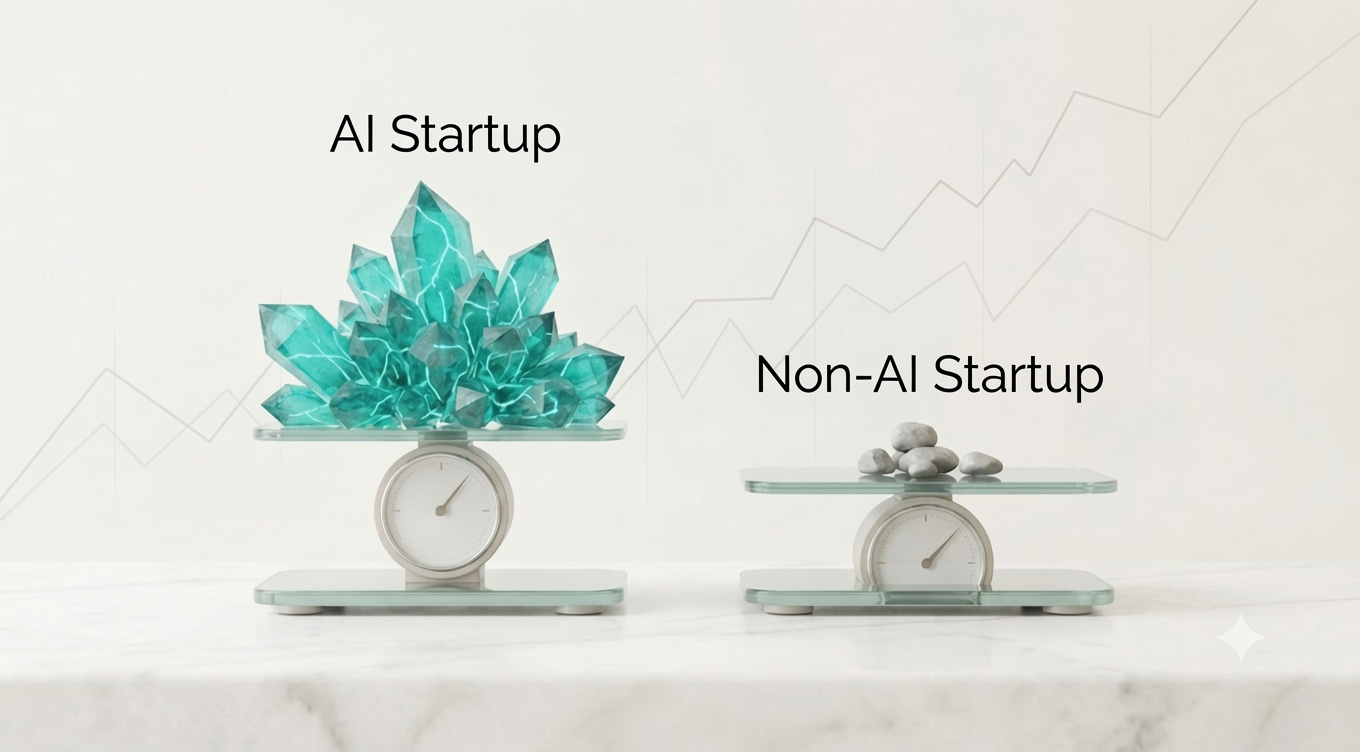
If you’ve heard that AI startups raise at roughly a 30% premium over comparable non-AI companies, the current data suggests that figure understates what’s actually happening in 2026. Carta previously found that AI seed valuations were 42% higher than non-AI peers — but that figure is based on 2024 data, and the gap has widened considerably since.
Carta’s Q1 2026 State of Private Markets report, drawn from its own platform data covering more than 50,000 startups, puts the current Series A gap in stark terms: an AI foundational-model startup at Series A may be raising at a median valuation around $300 million, compared with $55 million for a non-AI startup at the same stage. That’s not a 30% premium. That’s a company in the same funding stage being valued at roughly 5.5x a comparable non-AI peer — and this is 2026 data, not a carried-over 2024 figure.
It’s worth being precise about what’s being measured here, because different datasets answer slightly different questions. Carta’s $300M figure specifically reflects foundational-model companies — the smaller, higher-profile group building base AI models — rather than the broader population of “AI-attached” startups using AI as a feature. Other 2026 benchmark sets that include the wider AI-attached category show a less extreme but still substantial gap, with Series A pre-money valuations running higher for AI-native companies than for comparable SaaS businesses at similar revenue.
The US venture market is increasingly operating in two lanes: AI companies attracting premium valuations at every stage, and non-AI startups facing a more selective, slower-growth funding environment. This isn’t editorializing — it’s the structural pattern PitchBook’s own Q1 2026 data shows when AI and non-AI companies are placed side by side at the same funding stage.
How the Premium Grows at Every Stage
The gap between AI and non-AI valuations isn’t static — it compounds as companies move through funding rounds. PitchBook’s Q1 2026 data shows the premium widening dramatically by the time companies reach growth stage.
| Stage | AI median pre-money | Non-AI median pre-money | Source |
|---|---|---|---|
| Series A (foundational AI model) | $300M | $55M | Carta, Q1 2026 |
| Series A (all companies, median) | $62M | — | PitchBook-NVCA, Q1 2026 |
| Series C (median, all companies) | $579M | — | PitchBook-NVCA, Q1 2026 |
| Series D+ | $4.7B | $1.3B | PitchBook, Q1 2026 |
A caveat worth stating plainly: the $300M figure is specific to foundational-model startups — companies building base AI models themselves, like the smaller peers of OpenAI or Anthropic — not the broader population of companies simply using AI. Carta’s own data shows foundational model companies account for just 14.2% of total capital despite commanding that outsized valuation, meaning this extreme premium concentrates in a narrow slice of the AI category rather than across every startup with “AI” in its pitch deck.
Other 2026 benchmark datasets that track the wider “AI-attached” category — companies using AI as a core feature without building foundational models — show a less extreme but still real gap, with some reporting AI-native Series A revenue multiples in the 30x–60x range against 15x–20x for comparable B2B SaaS companies. These figures come from aggregated industry benchmark trackers rather than a single named research house, and should be read as directional rather than exact.
Why Investors Are Actually Paying More
The premium isn’t pure sentiment, even though sentiment plays a real role. There are structural reasons investors are willing to underwrite higher multiples for AI companies specifically.
THE CAPITAL FLOW TELLS THE STORY
Crunchbase reported approximately $300 billion in global venture funding in Q1 2026, with roughly $242 billion — about 80% — going to AI companies. PitchBook’s independent tracking arrives at a similar concentration: AI-sector funding alone hit $255.5 billion in Q1 2026, already surpassing the entire full-year 2025 AI total in a single quarter. On Carta’s own platform specifically, more than 60% of all venture capital invested in Q1 2026 went to AI companies — the highest share Carta has recorded to date.
When that much capital is chasing a finite number of credible AI deals, prices rise simply on supply and demand, independent of any company-specific merit. PitchBook’s research notes that in Q1 2026, every $0.90 demanded by a venture-growth-stage AI startup was met by $1 in available supply — sellers’ market conditions that don’t exist anywhere else in venture right now.
But concentration of capital isn’t the whole story. Investors point to genuinely different unit economics: AI companies can reach meaningful revenue with smaller teams and faster iteration cycles than traditional software, and the believed ceiling on AI-native products — automating entire workflows rather than augmenting them — implies a larger total addressable market per company. Whether that belief holds up is a separate question, but it’s the belief driving the multiple.
Not All “AI” Gets the Same Premium
The phrase “AI startup” is doing a lot of work in these statistics, and it’s worth breaking apart. The premium is wildly uneven depending on what kind of AI company you actually are.
Core AI Infrastructure
~79.7x EV/Revenue (Q1 2026)
Foundation model providers and core infrastructure plays. The highest multiples in the market, driven by scarcity of credible players and infrastructure lock-in.
Applied / Vertical AI
9x–12x typical, up to 30x with IP
Industry-specific tools (legal, HR, PropTech). Legal AI firm Harvey commands ~80x revenue — an outlier driven by defensibility, not category alone.
“GPT-wrapper” Products
Compressed, often rejected outright
Thin UI layers on top of existing foundation models with no proprietary data or workflow lock-in. Investor consensus in 2026: this category is dead money.
IP-Defended AI
25.8x vs. 18.2x for undefended peers
Companies with granted patents and trade secret programs achieve a documented 15–20% premium over otherwise-identical competitors without IP protection
The pattern across multiple datasets points the same direction: defensibility, not the AI label itself, appears to be what investors are actually pricing. One industry analysis of 575 AI companies (Finro Q1 2026 dataset, as cited by valuation advisory firm Beyond Elevation) found that late-stage startups with completed IP audits achieved a median 25.8x revenue multiple, compared to 18.2x for those without structured IP portfolios. That figure comes from a single industry research source rather than a major data provider like Carta or PitchBook, so it should be treated as directional rather than a definitive market-wide statistic — but it’s consistent with the broader trend toward defensibility-based pricing showing up across the larger datasets above.
The Other 19%: What Non-AI Founders Are Facing
The flip side of the AI premium is a real cost for everyone else. One Q1 2026 venture capital analysis estimated non-AI startups captured roughly 19% of that quarter’s record funding total — about $58 billion spread across robotics, manufacturing, defense tech, and enterprise software, with the remainder concentrated in just four frontier AI labs. This sector breakdown comes from an independent venture analysis rather than Carta or PitchBook directly, but it’s directionally consistent with the concentration both of those research houses have separately confirmed.
This compression isn’t entirely bad news for non-AI founders willing to look at it differently. The same analysis suggests non-AI enterprise software companies are raising at noticeably lower ARR multiples than comparable AI businesses — meaning better entry prices for investors who are comfortable with operational complexity and longer sales cycles, and arguably a more honest valuation that isn’t propped up by category momentum.
“While AI companies burn through $10M+ seed rounds training models and acquiring users, enterprise software companies can reach $1M ARR on $2-3M of seed capital.” — Q1 2026 Venture Capital Analysis
The Risk Hiding Inside the Premium
The premium is real, but it’s also a setup for a specific kind of pain later. If your seed round pre-money valuation lands well above the current median, you’re now under much greater growth pressure heading into Series A — and a meaningfully higher risk of a down round if you don’t hit those marks.
This isn’t theoretical. Founders who raised at peak 2021-2022 valuations and missed their milestones have had to face exactly this conversation with new investors: explain that the old number reflected an overheated market, not the underlying business, and reset expectations accordingly. The AI premium of 2026 carries the same risk in miniature — a company priced for category momentum needs to eventually show the metrics that justify the multiple, or the next round prices in the correction.
Verdict
THE LUDICARC TAKE
The AI valuation premium is real, it’s larger than the commonly cited 30% figure at most stages, and it compounds dramatically as companies move from seed to growth — reaching roughly 4x at Series D+ per PitchBook’s Q1 2026 data. But the premium is not uniform. It concentrates heavily in companies with genuine defensibility — proprietary data, IP protection, workflow lock-in — and it is conspicuously absent from thin wrapper products that investors are now actively discounting.
For founders: raising at the AI premium is not free money. It’s a forward commitment to growth metrics that match the multiple you accepted. For investors: the four-factor scoring investors are now running — IP defensibility, data moat, revenue quality, market timing — suggests the easy “any AI gets a premium” era is already narrowing into “only defensible AI gets a premium.” The companies still benefiting from a flat category tailwind in 12-18 months will be a smaller group than today.
SOURCES
Carta, “State of Private Markets: Q1 2026” — Series A foundational-model vs. non-AI median pre-money valuations ($300M vs. $55M); over 60% of Q1 2026 capital on Carta went to AI companies.
Carta, “Record-Setting Early-Stage Valuations” (2024 data) — original 42% seed-stage AI valuation premium figure, since superseded by larger gaps in 2026 data.
PitchBook, Q1 2026 US VC Valuations and Returns Report; PitchBook-NVCA Venture Monitor Q1 2026 — Series D+ AI ($4.7B) vs. non-AI ($1.3B) median pre-money valuations; Series A ($62M) and Series C ($579M) medians.
PitchBook, Q2 2026 Analyst Note “LP Co-Investments in US VC: Chasing AI at a Price” — Series D+ AI premium confirmed at ~4x; venture-growth AI demand-supply ratio.
Crunchbase, Q1 2026 global venture data (~$300B total, ~$242B to AI companies); PitchBook Q1 2026 AI VC Trends report ($255.5B AI-sector funding).
Beyond Elevation, analysis of Finro Q1 2026 dataset (575 AI companies) — IP-defensibility revenue multiple comparison (25.8x vs. 18.2x). Independent industry research, not a primary data provider.
Angel Investors Network, “Q1 2026 Venture: Non-AI Startups Own the Overlooked 19%” — non-AI sector funding breakdown. Independent venture analysis, not a primary data provider.