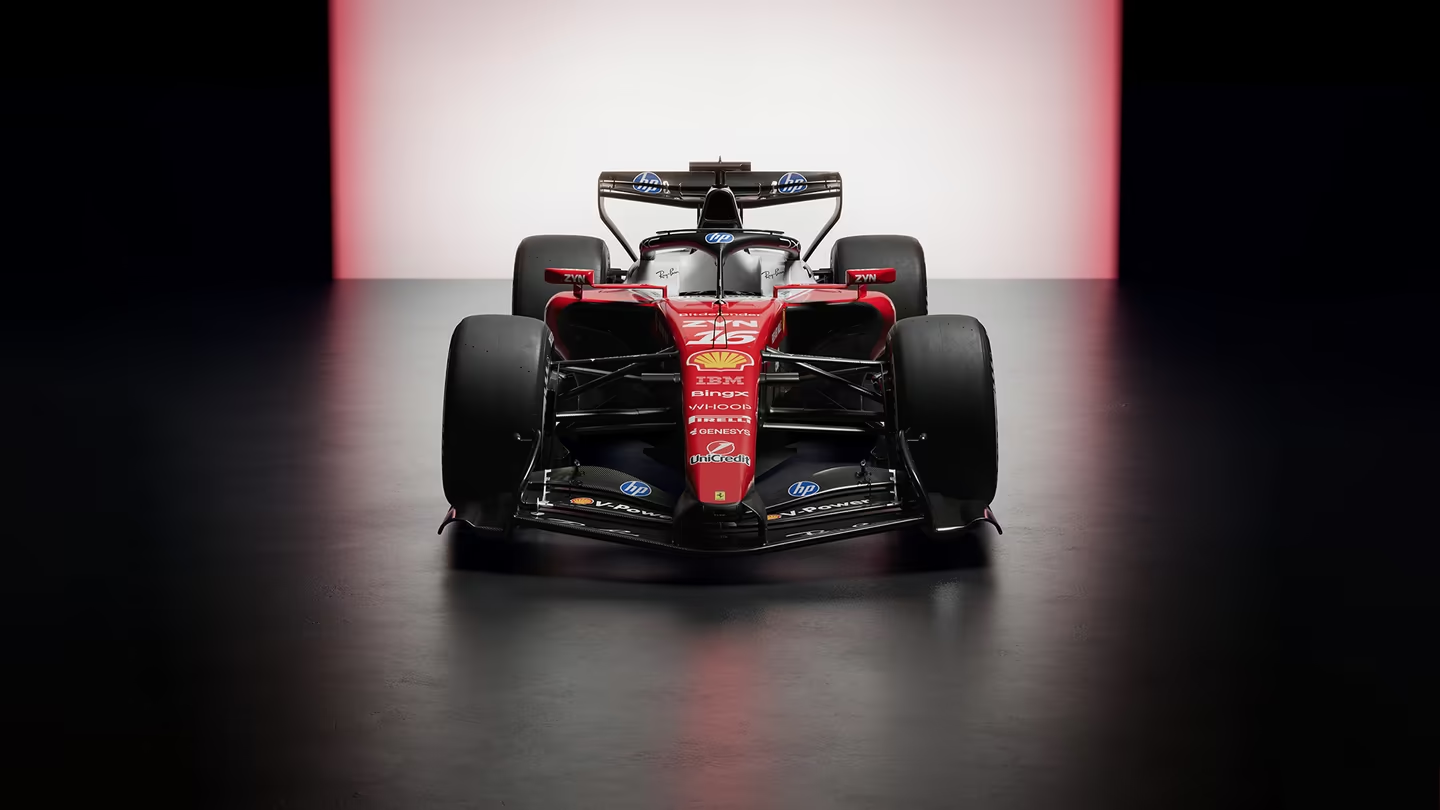
The 2026 season is the biggest regulatory reset in F1 history. New engines, active wings, sustainable fuel, and a completely redesigned chassis — Ferrari had to rebuild almost everything from scratch.
When Ferrari unveiled the SF-26 at Fiorano on January 23rd, 2026, it was not a simple refresh. Codenamed Project 678, it is the first Ferrari built entirely around 2026’s ground-up regulatory overhaul — new power unit rules, new aerodynamics, and a fundamentally different philosophy for how an F1 car generates speed. Here is what changed, and why it matters.
A New Engine Era — The 50/50 Power Split
The most significant change is under the bodywork. For the past decade, around 80% of an F1 car’s power came from the internal combustion engine. In 2026, that balance has been redrawn almost equally — roughly half from the 1.6-litre V6 turbo, and half from electric power.
The key to this shift is a much more powerful MGU-K — the motor generator that drives the rear wheels. It now delivers 350kW, nearly three times what it produced before. To make room for this, the MGU-H — a heat-recovery component attached to the turbocharger that was notoriously difficult and expensive to develop — has been removed entirely. Ferrari’s power unit team described this as a complete architectural rethink, not an evolution of what came before. The cars also run on a 99% sustainable fuel blend, which Ferrari’s engine has been specifically calibrated around.
50%
OF TOTAL POWER NOW ELECTRIC
350kW
MGU-K OUTPUT — 3× PREVIOUS UNIT
99%
SUSTAINABLE FUEL BLEND
Active Aerodynamics Replace DRS
DRS — the rear wing flap system F1 has used since 2011 — is gone. In its place, every 2026 car now features full active aerodynamics on both front and rear wings. On straights, the flaps automatically open to reduce drag and boost top speed. Through corners, they close back up to maximise downforce and grip. This happens continuously throughout every lap, not just at designated zones.
Ferrari pushed this concept hard during pre-season testing in Bahrain, briefly trialling a radical upside-down rotating rear wing design that drew attention from every technical analyst in the paddock. They reverted to a conventional solution the same day — but the experiment signals how aggressively they explored the edges of the new regulations.
Three New Driver Modes
The new hybrid and aero systems have changed how drivers manage the car mid-race. Three distinct power modes now define on-track strategy:
MODE #1
Boost Button
Manual max power deployment at any point on the lap — for attack or defense.
MODE #2
Recharge Mode
Lift off throttle to harvest energy aggressively — active aero is disabled during this phase.
MODE #3
Overtake Mode
Within one second of the car ahead, gain extra electrical energy for the following lap. DRS’s true replacement.
Suspension & Chassis Rethink
Ferrari switched from pullrod to pushrod suspension at both ends — aligning with Mercedes and Red Bull under the new regulations. The change reflects the aerodynamic priorities of 2026, where managing ride height and rear stability is critical for feeding airflow into the redesigned diffuser.
The car is also physically smaller: shorter wheelbase, narrower body, narrower tyres. The design team’s goal was functional simplicity — a car flexible enough to develop aggressively as track data accumulates across the season.
The Diffuser — Ferrari at the Limit
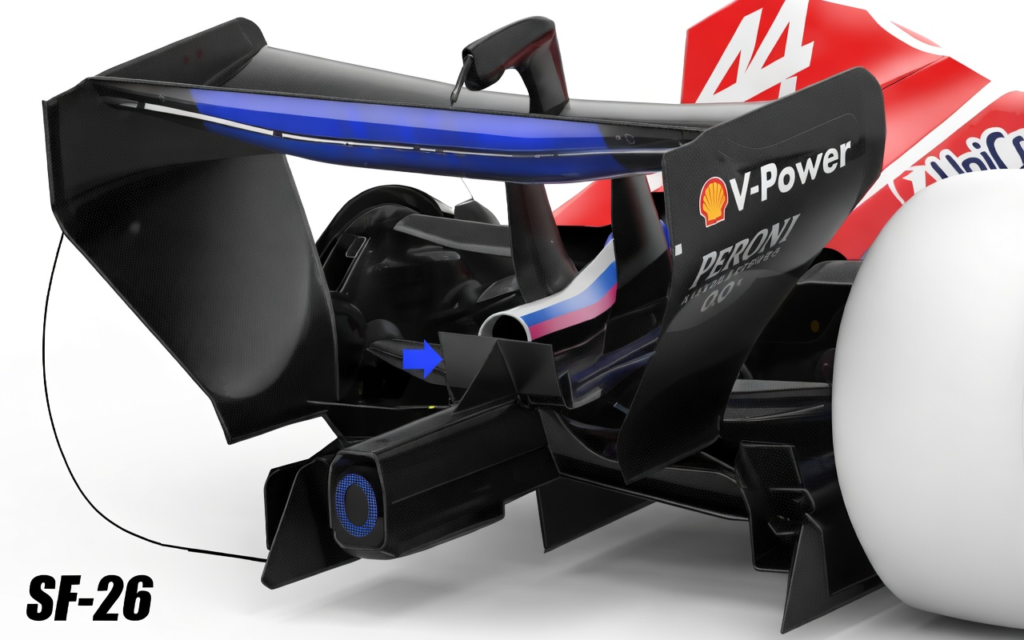
The long ground-effect tunnels of the 2022–2025 era are gone, replaced by flatter floors with larger extended diffusers. Ferrari and Mercedes both feature a distinctive slot in the lower bodywork around the diffuser — allowing external airflow to energise the diffuser’s inner wall, preventing separation and generating more downforce.
Ferrari’s interpretation reportedly pushed the permitted volumes so far it required multiple discussions with the FIA to confirm legality.
Early Season & What Comes Next
The SF-26 debuted at the Australian Grand Prix with Leclerc and Hamilton. Ferrari’s race starts were among the quickest on the grid — Leclerc led into turn one in Melbourne. Against Mercedes there is a gap of roughly half a second overall pace, but Ferrari may qualify for F1’s Additional Design and Upgrade Opportunities rule, which allows manufacturers more than 2% behind the power unit benchmark to introduce mid-season upgrades. If granted, the gap could close considerably before the season’s second half.
The 2026 season is still in its opening chapter. Every major regulation change in F1 history has reshuffled the order — 2026 is no different. Ferrari have rebuilt intelligently, and with Hamilton pushing hard for a first title in red, this fight is far from over.