
- EV Sales Surge in South America: Chinese Brands Dominate the Market
- The Boom: From Niche to Mainstream
- Chinese Brands Dominate: Why They’re Winning
- Tesla’s Absence: Logistics, Tariffs, and Strategy
- Broader Impacts: Economy, Environment, and Geopolitics
- Challenges That Remain
- Bottom Line
- more on automobiles
EV Sales Surge in South America: Chinese Brands Dominate the Market
South America is experiencing one of the fastest electric vehicle (EV) growth stories in the world. In 2024, EV sales across the region doubled, pushing the overall market share to around 4%. By 2025, the numbers climbed even higher, with Chile reaching a record 10.6% EV share in new car registrations, Brazil hitting 9.4% in August, and Uruguay achieving an impressive 28% in the third quarter.
These gains are being driven almost entirely by affordable Chinese models such as BYD’s Seal sedan and MG’s ZS EV crossover. Tesla, once the global EV leader, has zero market presence in the region so far. High tariffs, complex logistics, and a strategic focus elsewhere have left the door wide open for Chinese automakers. This rapid shift is not just changing how South Americans drive — it could reshape the entire global EV industry by 2030.
The Boom: From Niche to Mainstream
Just a few years ago, electric vehicles were a rare sight on South American roads. Most drivers stuck with traditional gasoline or diesel cars because EVs were too expensive and charging stations were almost nonexistent. That picture has changed dramatically. According to the International Energy Agency’s Global EV Outlook 2025 report, EV penetration across South America (including Mexico and Central America) doubled to approximately 4% in 2024. The momentum continued strongly into 2025, turning EVs from a luxury curiosity into a practical choice for many middle-class families.
Several factors are working together. Governments in Chile, Brazil, Uruguay, and Colombia have introduced tax breaks, lower import duties on EVs, and small purchase incentives. At the same time, global battery prices have fallen sharply, making Chinese-built EVs far more affordable. Charging networks are also expanding quickly in major cities — São Paulo, Santiago, and Buenos Aires now have hundreds of new public stations. The result is clear: real customers are buying. By September 2025, Chile’s EV market share hit 10.6%, Brazil reached 9.4%, and Uruguay’s 28% figure stands out as one of the highest in any emerging market worldwide.
To put this in perspective, global EV sales reached about 18% of all new cars in 2025. Europe leads with 56%, China with 51%, but South America is now growing faster than almost any other region outside of Asia. This acceleration shows that even countries with lower average incomes can adopt electric mobility when the right products and policies come together.
Chinese Brands Dominate: Why They’re Winning
The real story behind South America’s EV surge is the overwhelming success of Chinese manufacturers. Brands such as BYD, MG (owned by SAIC), Chery, and Great Wall Motor have flooded the market with practical, well-equipped electric cars priced under $25,000 — often half the cost of comparable models from Western brands.
These vehicles offer real-world ranges of 300 miles or more, fast charging, modern safety features like automatic emergency braking, and spacious interiors that appeal to local families.
Look at the top performers from January to September 2025:
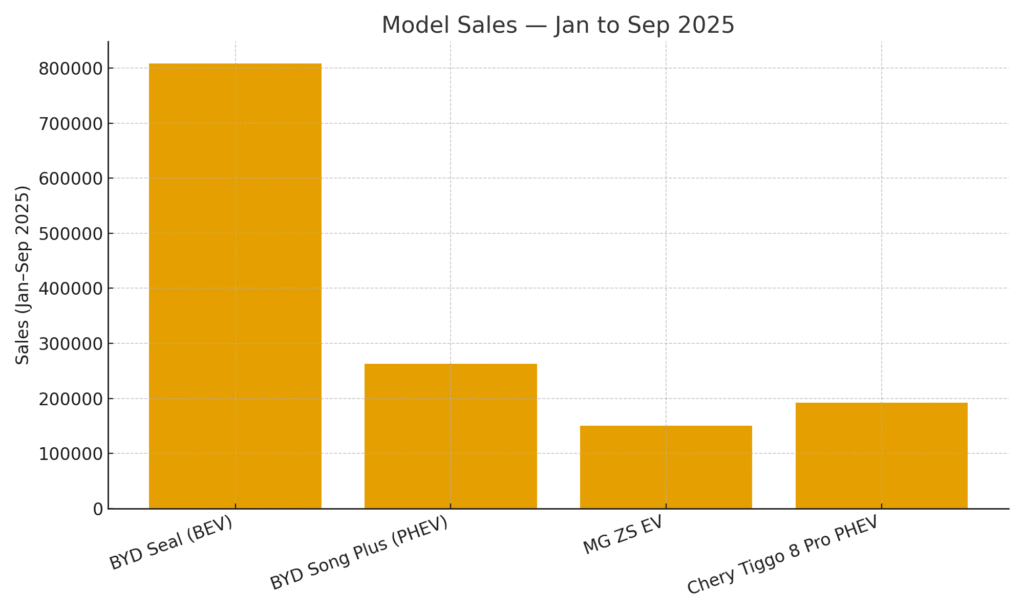
- BYD Seal (pure electric sedan) — over 808,000 units sold worldwide, with especially strong demand in Brazil and Chile
- BYD Song Plus (plug-in hybrid) — 262,000 units, very popular in Uruguay and Argentina
- MG ZS EV — around 150,000 regional sales, a bestseller in Brazil and Colombia
- Chery Tiggo 8 Pro PHEV — 192,000 units, leading in Mexico and Peru
BYD alone now controls 20–30% of all EV sales in the region. The secret to their success is simple: they build cars that match what South American buyers actually need — affordable prices, good range for daily commuting, and features that feel premium without the premium cost.
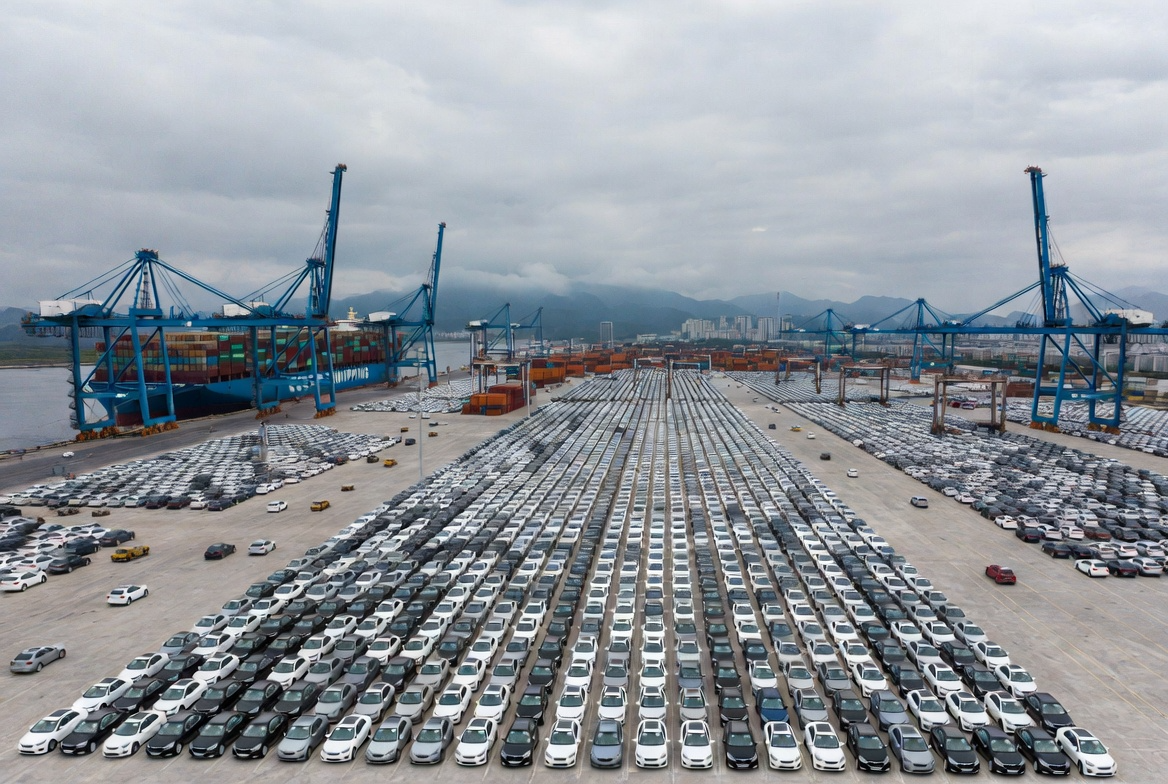
At Peru’s new Chancay megaport, which opened in November 2025, thousands of Chinese EVs sit ready for delivery across the continent. This efficient supply chain gives Chinese brands a huge advantage over competitors who must ship from much farther away.
Tesla’s Absence: Logistics, Tariffs, and Strategy
One of the most surprising parts of this story is Tesla’s complete absence. The American company has no factories, no official showrooms, and no service network anywhere in South America south of Mexico. High import tariffs — up to 35% in Brazil — make Tesla vehicles extremely expensive to bring in. Long shipping distances from the United States or Europe add even more cost and delay.
While Tesla has focused its energy on Europe, China, and North America, Chinese brands quietly built local partnerships and even opened factories, such as BYD’s new plant in Brazil in 2024.
A November 2025 executive order from the United States added another layer of complexity, imposing 25% duties on certain Chinese-made heavy-duty vehicles and 10% on buses. This pushed several South American governments to protect their own markets, indirectly favoring brands already producing or assembling locally. Tesla has announced plans to enter the region in 2026 through exports from its Mexico factory, but analysts warn the market may already be locked in by then. Chinese brands have built strong brand loyalty and dealer networks that will be hard to challenge.
Broader Impacts: Economy, Environment, and Geopolitics
The rise of Chinese EVs is bringing real changes to South America. Economically, the traditional dominance of Volkswagen, Ford, and General Motors is shifting. New assembly plants and investments are creating thousands of jobs. Brazil alone recorded significant auto-sector investments between January and September 2025, with more money flowing into EV production. Countries are also gaining better access to modern technology and manufacturing know-how.
From an environmental standpoint, the benefits are obvious. Cities like São Paulo and Santiago suffer from heavy traffic pollution. Replacing even a small percentage of gasoline cars with EVs is already helping to clean the air and reduce greenhouse gas emissions. Many of these new Chinese models can also run on cleaner energy sources as countries expand their renewable power grids.
Geopolitically, the story is more complex. Some analysts describe China’s EV expansion as a form of soft-power influence — building economic ties and long-term relationships across Latin America. Others see it as a smart business strategy that fills a gap left by slower-moving Western companies. Either way, the shift is forcing traditional automakers to rethink their plans for the region.
Challenges That Remain
Despite the impressive growth, South America still faces real hurdles. Charging infrastructure covers only about 10% of what Europe has today, making long-distance travel difficult outside major cities. Many rural areas have almost no public chargers. Global EV sales have also shown volatility — recent slowdowns in the United States remind everyone that demand can fluctuate when subsidies change or economic conditions tighten.
There are also concerns about over-reliance on Chinese supply chains, intellectual property protection, and the long-term sustainability of local jobs if most vehicles continue to be fully imported. Governments will need to balance incentives with smart policies to ensure the boom benefits local workers and industries.
Bottom Line
South America’s EV revolution is being written by Chinese brands. Affordable, practical models from BYD, MG, Chery, and others have turned electric vehicles into a mainstream choice faster than anyone expected. Tesla’s absence has created an opening that Chinese companies have seized with impressive speed and scale. By 2030, the region could look a lot like today’s China — a place where EVs dominate new car sales and reshape entire industries.
This is excellent news for South American consumers who now have access to modern, clean, and affordable transportation. For traditional automakers in the United States and Europe, it is a clear wake-up call. The global EV race is no longer just about technology — it is also about who can deliver the right product at the right price in the right markets. The next few years will show whether Western brands can catch up or whether Chinese leadership in South America becomes the new normal.