
- What Is a W18 Engine, Anyway?
- The Design: A Compact Powerhouse with Turbo Dreams
- How It Differs from Porsche’s Famous Flat Engines
- Why Now? Porsche’s Big ICE Push in an EV World
- Potential Applications: Where Could This Engine Actually Go?
- Pros of the W18 Design
- Cons of the W18 Design
- Bottom Line
- more on automobiles
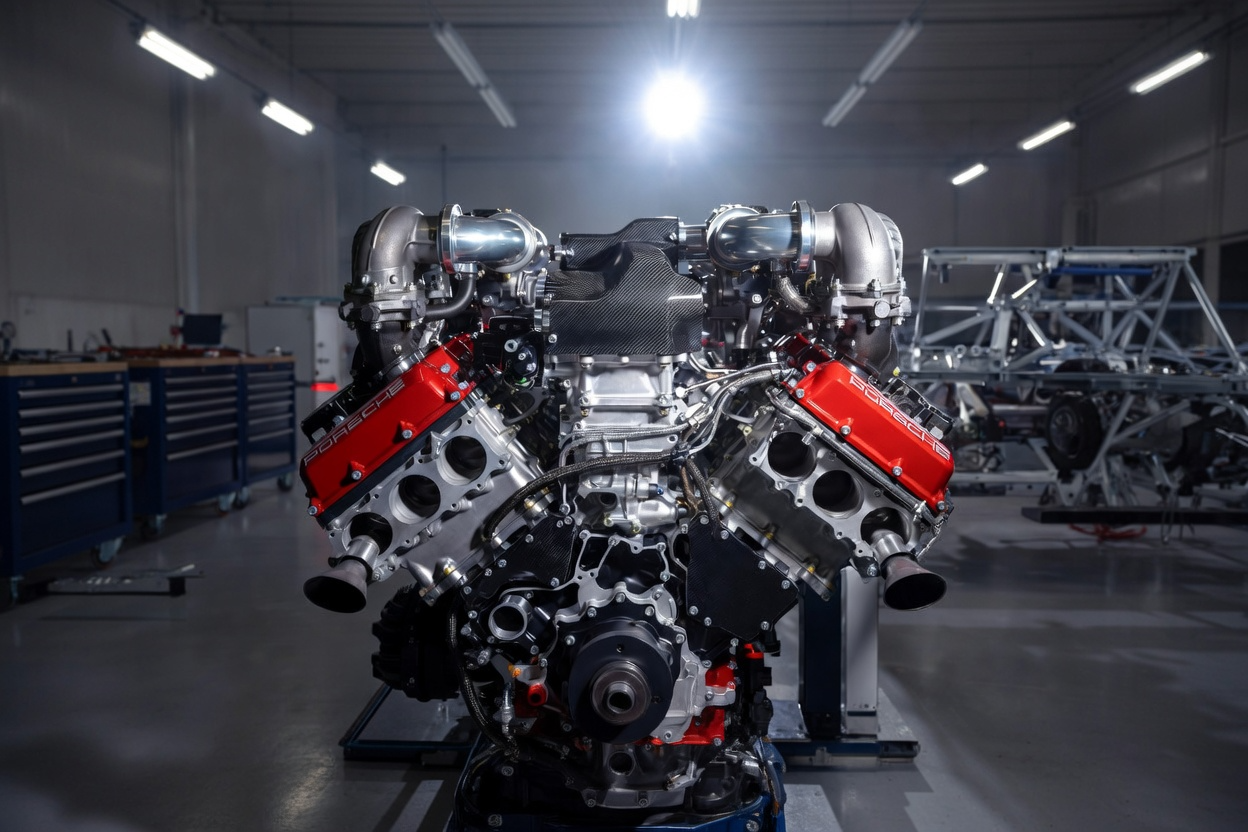
Porsche surprised the automotive world in October 2025 when it published a patent for a completely new kind of engine: a true W18. This is not just another small update — it is a radical design with three separate banks of six cylinders arranged in a tight “W” shape around a single crankshaft.
The patent even hints at triple-turbocharging, which could create massive power in a surprisingly small package. Porsche is famous for its flat “boxer” engines that have powered 911s for decades, so this W18 feels like a bold experiment. It might one day power a successor to the legendary 918 Spyder hypercar, or it could stay on paper as a pure research project. Either way, it shows how seriously Porsche is still investing in combustion engines even as the world moves toward electric cars. Here is a clear, step-by-step breakdown of what this patent really means.
What Is a W18 Engine, Anyway?
Imagine taking three straight-six engines and tilting them together so they form a “W” when you look at them from the front. That is exactly what a true W engine does. All 18 cylinders share one long crankshaft in the middle, but they sit in three separate banks angled at about 60 degrees each.
This is very different from the famous W16 engine in the Bugatti Chiron. That W16 was basically two V8s bolted together — Porsche calls those “fake” W engines. The new Porsche design uses three completely separate cylinder heads, making it a genuine W layout.
The patent is flexible too. While the main drawing shows 18 cylinders (six in each bank), Porsche notes the same basic idea can be scaled down to a W9 (three cylinders per bank), a W12, or a W15. This gives engineers lots of options depending on how much power or efficiency they need.
The result is an engine that is very compact from front to back — roughly the same length as a regular straight-six — yet it packs almost three times as many cylinders. That kind of packaging trick is exactly what hypercar designers dream about.
The Design: A Compact Powerhouse with Turbo Dreams
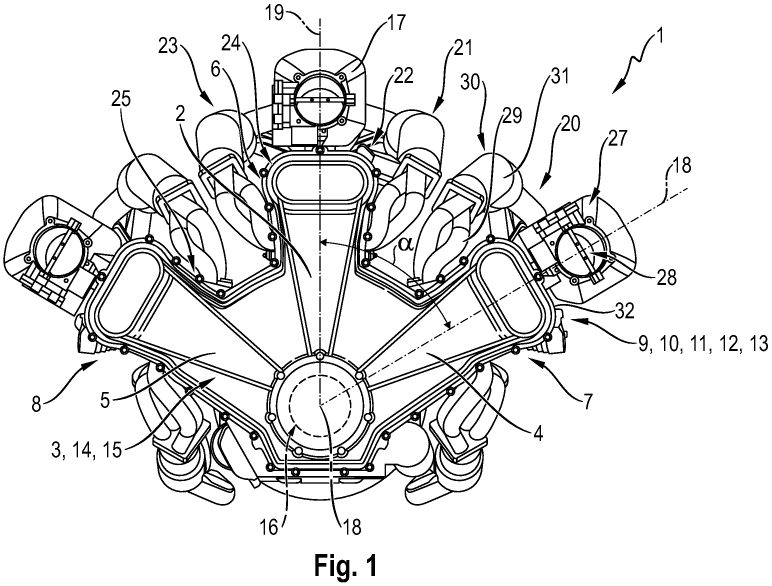
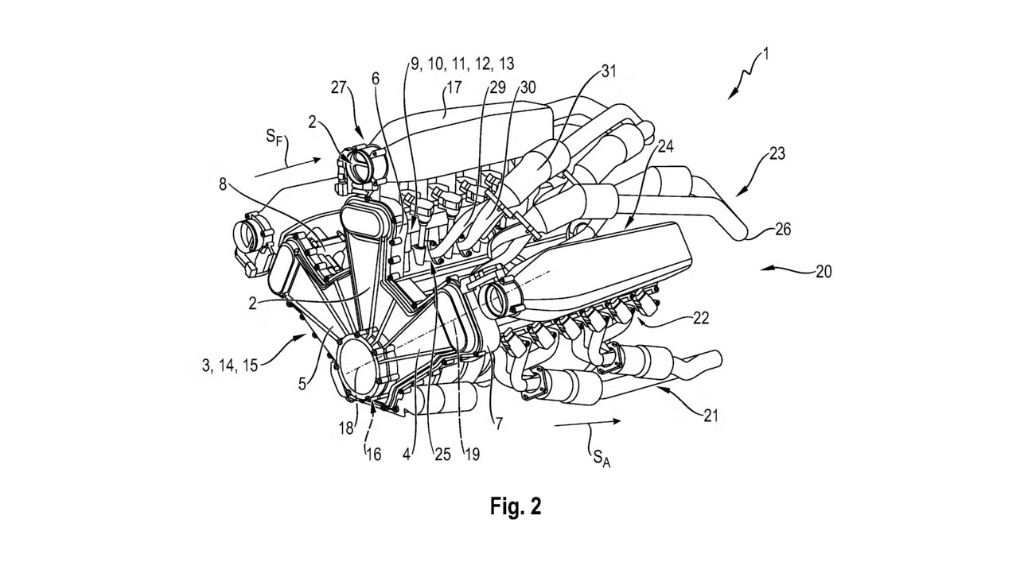
Space is everything in a supercar. Porsche’s patent focuses on “space optimization,” and the drawings prove it. The entire W18 block is short and wide instead of long and narrow.
Air intake plenums sit right on top of each cylinder head, letting cool air flow straight down into the cylinders with almost no bends or restrictions. This means more power and less heat. Exhaust ports are placed low on the sides, so hot gases exit quickly without cooking the rest of the engine.
The most exciting part is the turbocharging plan. The design allows one turbocharger per bank — that is three turbos total. Triple-turbo W18 could easily produce 1,500 horsepower or more in a hybrid setup.
The patent even shows clever ways to route the exhaust and intake so everything stays balanced and smooth. Because the engine is so compact, it could fit in the tight engine bay of a mid-engine hypercar without forcing the whole car to grow bigger. Porsche also built in ways to reduce vibration, which is always a challenge with so many cylinders firing.
How It Differs from Porsche’s Famous Flat Engines
Porsche has always loved flat (boxer) engines because they sit low in the car, giving a perfect center of gravity and razor-sharp handling. That is why the 911 feels so special.
A flat-18 would be possible in theory, but it would be enormous — two huge banks of nine cylinders each. The W18 is completely different: it is taller but much shorter from front to back, making it perfect for cars where space is limited.
Porsche is not throwing away its flat engines. The latest 911 GTS hybrid still uses a flat-six combined with electric motors. The W18 is more like a special project for extreme performance when a regular flat engine simply cannot deliver enough power in a small space.
It is an exciting new direction that shows Porsche is willing to try wild ideas to keep the thrill of combustion alive.
Why Now? Porsche’s Big ICE Push in an EV World
Just a few years ago, Porsche talked about selling 80 % electric cars by 2030. That plan changed after 2025. EV sales slowed, profits dropped sharply, and customers kept asking for the sound and feel of real engines.
Porsche responded by doubling down on hybrids and synthetic e-fuels — carbon-neutral fuels that work in normal engines. The W18 patent fits perfectly into this new strategy. It can run on regular gasoline today and switch to e-fuels tomorrow, giving enthusiasts the drama they love while still cutting emissions.
Many experts believe this engine is being developed with a future 918 Spyder successor in mind. That car could arrive after 2025 and target more than 750 horsepower — something a W18 hybrid could deliver easily while still fitting in a sleek mid-engine layout.
Potential Applications: Where Could This Engine Actually Go?
The most obvious home is a new hypercar. Picture a 918 successor with a triple-turbo W18 plus electric motors: over 1,000 horsepower, instant electric torque, and that unmistakable multi-bank exhaust roar. It would continue the bloodline of Porsche legends like the 959 and 918.
The compact size also makes it interesting for other models. A slightly smaller W12 or W15 version could fit in a high-performance GT or even a next-generation Cayenne SUV for those who want luxury with extreme power.
Even if the full W18 never reaches showrooms, many of its smart ideas — better intake flow, triple-turbo layouts, vibration control — will probably appear in future flat-six and flat-eight engines. Patents like this are how great technology spreads across an entire lineup.
Pros of the W18 Design
- The biggest advantage is raw power in a tiny package. With triple turbos and 18 cylinders, this engine could hit hypercar numbers while staying short enough for mid-engine cars.
- The three-bank layout with separate heads gives excellent airflow, cooler intake temperatures, and very smooth power delivery.
- Because it shares one crankshaft, it stays balanced and strong.
- Scalability is another huge plus — Porsche can build smaller W9 or W15 versions for different cars without starting from scratch.
- Most importantly, the W18 works perfectly with hybrid systems and synthetic e-fuels, so it can stay environmentally friendly without losing the emotional sound and feel that drivers love.
For anyone who enjoys the theatre of a high-revving engine, this design promises something truly special.
Cons of the W18 Design
- Of course, nothing this ambitious is simple. Building three separate cylinder heads, three turbos, and all the plumbing will be very expensive and complex.
- The taller shape might create new packaging headaches and could increase vibration compared with Porsche’s perfectly balanced flat engines.
- Weight could also be higher than a smaller V12 or turbo flat-six, which hurts fuel economy in pure combustion mode.
- In a world that is still pushing hard toward full EVs, a big 18-cylinder engine risks looking old-fashioned to some buyers.
- Regulations could get stricter, and if e-fuel stations do not appear quickly, the W18 might stay limited to a very small group of wealthy enthusiasts.
Development costs are so high that Porsche must be extremely sure the car it powers will actually sell.
Bottom Line
Porsche’s W18 patent is a thrilling reminder that combustion engines are far from finished. By packing 18 cylinders into a super-compact W layout with triple-turbo potential, Porsche has created a blueprint for extreme performance that EVs still cannot fully match in terms of sound, feel, and drama.
Whether this engine ever reaches a production car or simply inspires the next generation of flat engines and hybrids, it proves one thing: Porsche is determined to keep the internal combustion engine exciting, relevant, and emotionally alive well into the future.
For engine fans, 2026 just got a lot more interesting.