STATUS
Genesis: engineering complete, business case pending
REPORTED PRICE
~$136K, Korea (unconfirmed)
POSSIBLE REVEAL
H2 2026, if approved
POSSIBLE RELEASE
H1 2027, if approved
Most supercars begin their public life with a launch event and end it with a price list. The Genesis Magma GT has been stuck somewhere in between for more than a year. First revealed in November 2025 and updated with a full interior at this June’s 24 Hours of Le Mans, it has, according to Genesis CEO José Muñoz, cleared the engineering stage. What Muñoz has not said is that the car is actually going to be built.
Why Genesis Needs This Car More Than the Market Does
Genesis has spent just over a decade establishing itself as a luxury brand, and like every brand that has tried to move upmarket without deep historical prestige to lean on, it has run into the same limit: badge equity doesn’t transfer on its own. The G90 can match a Mercedes S-Class on space and technology, and the GV80 can out-spec an Audi Q7 on paper, but matching a spec sheet has never been the same thing as matching prestige.
Halo cars are how legacy luxury brands have historically closed that gap. A brand doesn’t need to sell many of them. It needs the car to exist, to be talked about, and to make the rest of the lineup feel like it belongs to the same story.
If approved for production, the Magma GT would become Genesis’ first purpose-built, mid-engined performance car, something Hyundai Motor Group has never attempted under the Genesis badge. Its proportions place it visually among established European exotics rather than anything else in the brand’s current lineup. Whether buyers, and the industry, are willing to see it the same way is a separate question entirely.
When Genesis returned to the Magma GT at Le Mans this June, the more telling update wasn’t the exterior, which kept the striking green paint from its debut rather than the fire-toned Magma orange the sub-brand takes its name from. It was the interior, shown publicly for the first time, that did the more interesting work: a cabin finished in the fiery orange the exterior itself avoided.
An Interior Built Like a Fine Watch, Not a Tablet
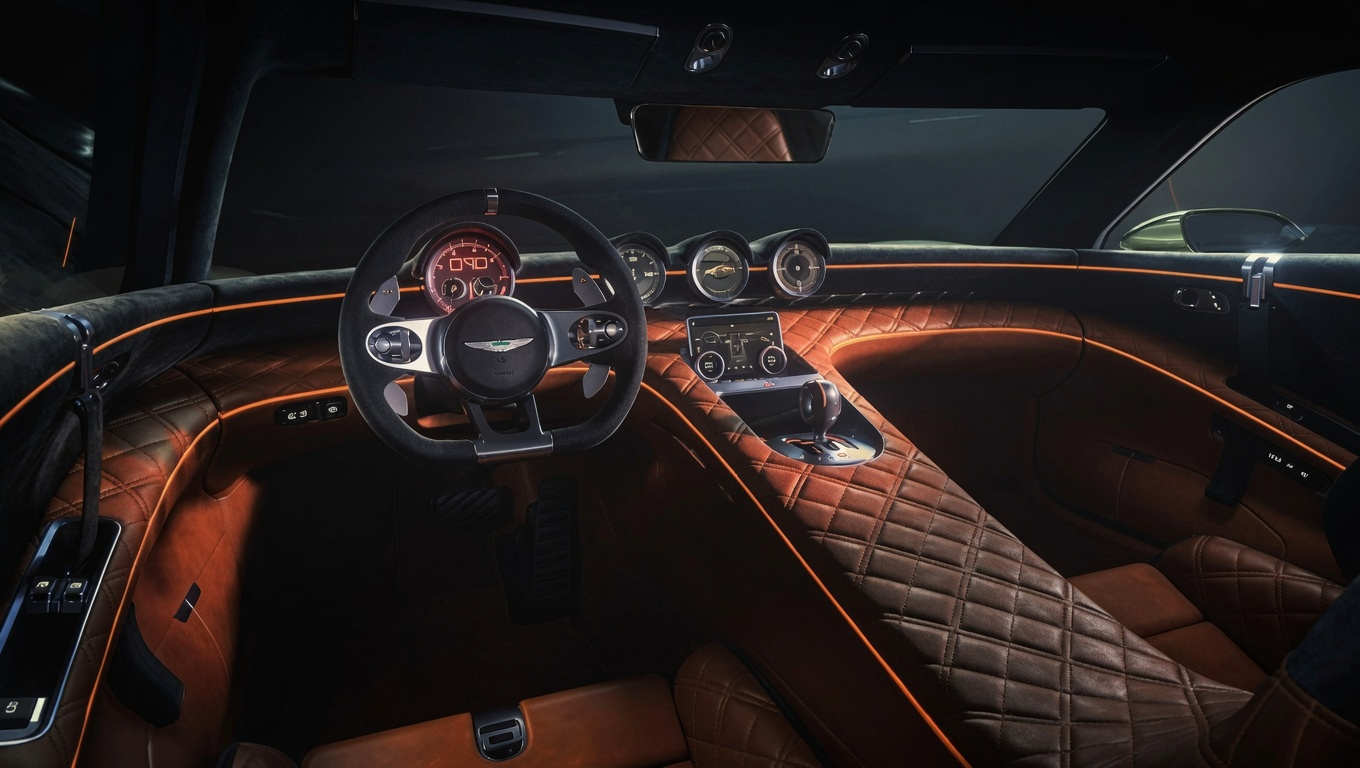


Rather than following the industry’s drift toward ever-larger touchscreens, Genesis built a cabin that feels mechanical rather than digital. Four analog-style displays, physical toggle switches, and a proper gated shifter give the interior the character of a traditional grand tourer rather than a rolling tablet, and the diamond-quilted leather, finished in the fire-toned orange the exterior withholds, is where the Magma name finally shows up. Genesis describes the result as reinterpreting the modern luxury GT experience, balancing performance, comfort, and craftsmanship, and it reads as a refined yet immersive cabin
that borrows more from grand touring tradition than typical supercar theatre.
Genesis named this car after magma, the molten rock associated with fire and orange. Yet the exterior, at its most detailed public reveal yet, stayed green, while that fire-toned orange only appears once you step inside. Whether that split is a deliberate design statement or simply a one-off paint choice for Le Mans hasn’t been clarified.
A CURIOS CHOICE
Genesis named this car after magma, the molten rock associated with fire and orange. Yet the exterior, at its most detailed public reveal yet, stayed green, while that fire-toned orange only appears once you step inside. Whether that split is a deliberate design statement or simply a one-off paint choice for Le Mans hasn’t been clarified.
The Business Case Genesis Still Has to Write
CEO José Muñoz has been unusually candid about where the Magma GT actually stands. According to him, Genesis evaluates any new product across three stages: scientific feasibility, which he says has been achieved, engineering readiness, also complete, and commercial viability, which is still being worked out. That third stage covers investment, pricing, expected volume, and how the car fits alongside the rest of Genesis’ lineup. Asked what would ultimately decide the car’s fate, Muñoz pointed to public reaction rather than anything internal to Genesis:
“We’re going to really go for it.”
José Muñoz, Genesis CEO, on the Magma GT’s chances, as reported by Autoblog
The Rule That Might Force the Decision Anyway
Genesis may not have complete freedom to walk away from this car even if the spreadsheet math gets difficult. Alongside the road-going Magma GT, the brand also revealed a Magma GT3 concept built to current GT3 racing regulations, aimed eventually at competing against racing versions of the Chevrolet Corvette, Ford Mustang, and Porsche 911. FIA rules require any GT3 race car to be based on a road-going model that is genuinely in production and on sale at the time of homologation, not a concept or show car. That requirement alone creates real pressure: if Genesis wants to actually race the Magma GT3, the road-going Magma GT cannot stay a concept indefinitely. If Genesis follows through on the GT3 program it has already previewed, building on its Le Mans Hypercar-class debut this year, the road car would need to enter production alongside it. Production itself doesn’t necessarily require an all-new factory line either. Low-volume specialists like Austria’s Magna Steyr, which already builds cars including the Toyota GR Supra and BMW Z4 for other manufacturers, could plausibly handle the kind of output Genesis would need, though nothing along those lines has been confirmed publicly.
IF IT HAPPENS
Multiple automotive publications have reported a possible production reveal in the second half of 2026 and a market release in the first half of 2027, at a starting price of roughly 200 million Korean won, or about $136,000 in Korea. None of this has been confirmed by Genesis, and US pricing, if the car reaches American shores at all, would likely be higher.
THE LUDICARC TAKE
Horsepower was never going to be the hard part.
Whether the Magma GT ever reaches a driveway won’t be decided by its output figures or its price tag. It will be decided by something no engineering team can build on its own: whether buyers, and the wider industry, are willing to see Genesis as a genuine performance brand rather than a well-appointed luxury one wearing a fast car’s clothes. Engineering can build a supercar. Reputation takes much longer.