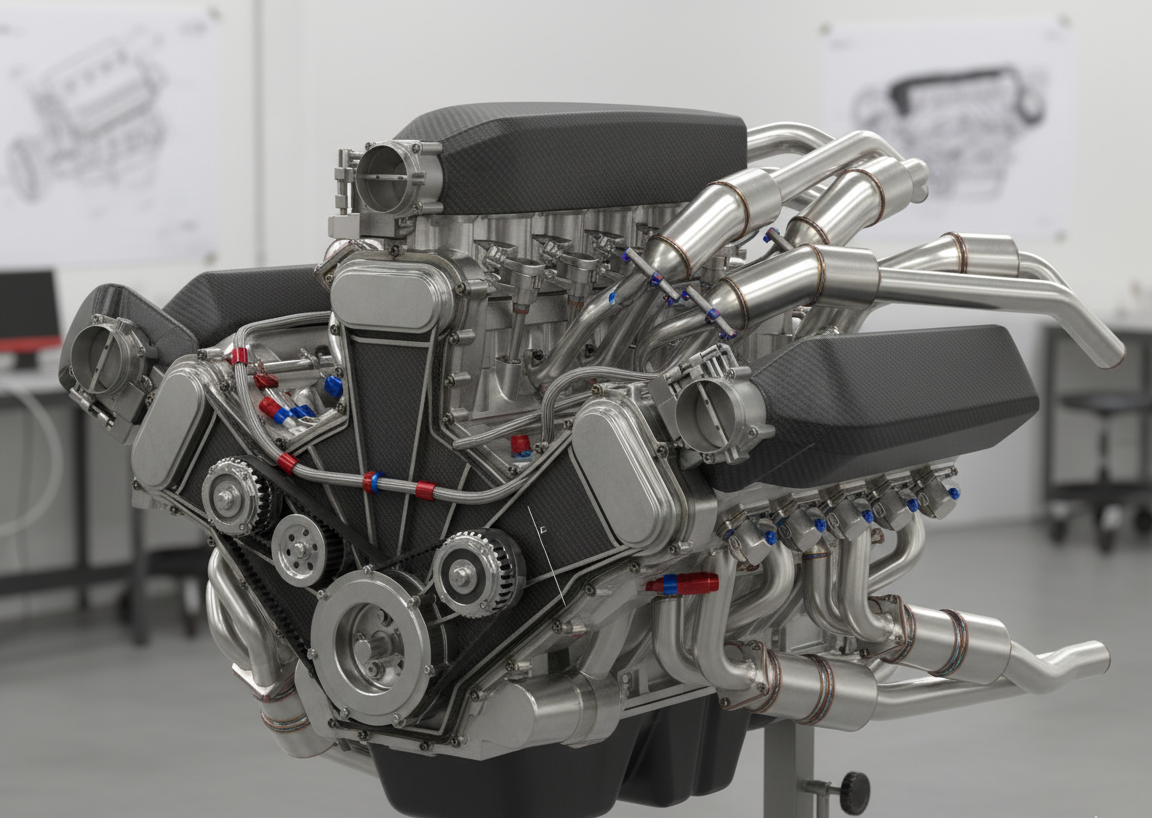
Porsche filed a patent in October 2025 for a true W18 engine – three banks of six cylinders in a compact W shape, with triple turbo potential. It’s not a flat engine (Porsche’s signature), but a wild ICE experiment for high performance in a small package. Could power a 918 successor or stay on paper – here’s the full breakdown.
What Is a W18 Engine, Anyway?
A W engine arranges cylinders in a “W” formation, like three inline engines angled around one crankshaft. Porsche’s version uses three separate banks at 60-degree angles, each with its own cylinder head – unlike VW Group’s “fake” W16 (two V8s sharing a crank). This creates a true W: compact, balanced, and potent.
The patent shows 18 cylinders (6 per bank), but Porsche notes it scales to 9, 12, or 15 cylinders for flexibility.
The Design: Compact Powerhouse with Turbo Dreams
Porsche’s W18 prioritizes “space optimization” – it’s as long as a straight-six but packs 18 cylinders.
Key features:
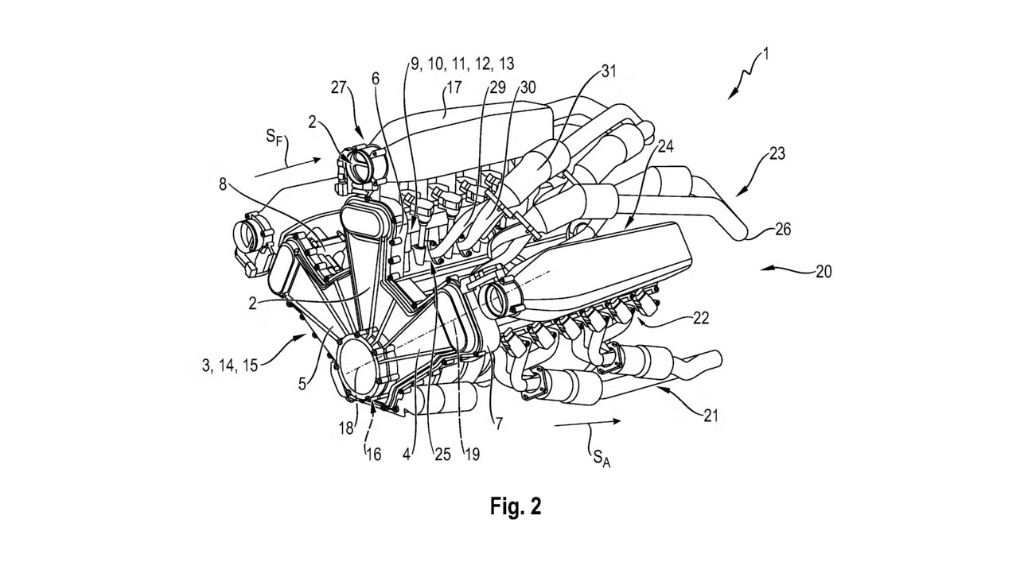
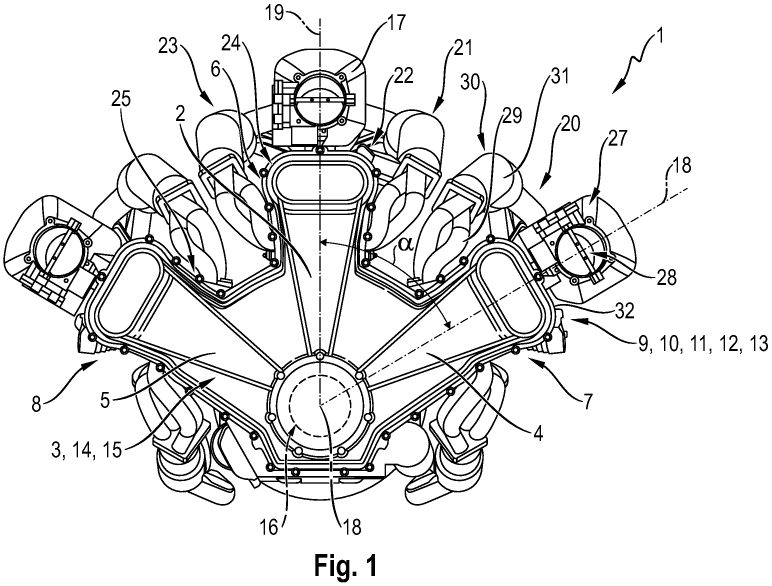
Three Banks, One Crank: Each bank (straight inline-6 in the diagram) angles 60 degrees from the others, sharing a common crankshaft for smooth firing.
Intake / Exhaust Setup: Air plenums sit atop each head for straight-down flow (less friction, cooler air = more power). Exhaust ports low on the sides keep heat away.
Turbo Potential: One turbo per bank = triple-turbo setup. Imagine 1,500+ hp in a package fitting a mid-engine supercar.
Scalability: Drop to three cylinders per bank for a W9 (tiny, efficient) or five for a W15 (balanced power).
This isn’t production-ready yet – filed April 2024, published October 2025 – but it hints at Porsche’s ICE R&D amid EV slowdowns.
How It Differs from Porsche’s Flat Engines
Porsche lives by flat (boxer) engines – low center of gravity, perfect balance for the 911’s handling. A flat-18? Unlikely; it’d be massive (two banks of nine cylinders). The W18 is a departure: taller but shorter, ideal for tight engine bays in hypercars.
It’s not replacing the flat-six (see 2025 911 hybrid), but exploring W for extreme output where flats hit limits.
Why Now? Porsche’s ICE Push in an EV World
Porsche scaled back its 80% EV-by-2030 plan after 2025 sales dips (profits down 67% H1). Hybrids like the 911 GTS (flat-six + electric) sell out, and e-fuels keep ICE viable. The W18 fits: carbon-neutral compatible, high-revving drama for enthusiasts.
Rumors tie it to a 918 Spyder successor (post-2025, 750+ hp target).
Potential Applications: Hypercar Heart?
918 Successor: 1,000+ hp hybrid W18 could revive the “959 lineage” – electric motors + triple-turbo roar.
Luxury GT: Shorter block fits SUVs like a next-gen Cayenne RS.
Testbed Tech: Ideas (intake flow, turbos) trickle to flat engines or e-fuel projects.
No confirmation – patents often shelf – but it signals Porsche’s hybrid future.
Pros:
The W18’s triple-turbo setup promises massive power output, potentially reaching hypercar levels. Its three-bank design shares a single crankshaft, making it structurally compact—as long as a straight-six but housing 18 cylinders. This layout allows optimized airflow, with intake plenums and dedicated heads per bank, improving performance. The engine’s scalability (from W9 to W15) also gives Porsche flexibility for different use cases. Because it could be compatible with synthetic (e-fuel) or hybrid systems, it offers a path for high-performance ICEs in a more sustainable future. For driving enthusiasts, the W18 promises unique sound and drama, delivering an emotional appeal that EVs often lack.
Cons :
On the downside, the three-bank W18 is likely to be very complex and expensive to develop and build, especially with triple turbos and custom cylinder heads. Its physical structure, while compact lengthwise, will be taller than traditional flat engines, which could introduce challenges in engine packaging and potentially increase vibration. The design may also add weight compared to V12 or smaller engines, reducing efficiency. In a world shifting toward EVs, the W18 risks being niche, appealing mainly to high-performance or luxury buyers—while competing with electrified powertrains. Finally, the economics of production and regulation may be difficult if stringent emissions rules tighten or synthetic fuel infrastructure doesn’t scale quickly.
Bottom Line
Porsche’s W18 patent is a bold ICE flex – 18 cylinders in a W that’s more efficient and packable than ever. Whether it powers a hypercar or inspires the next flat-six, it shows combustion’s not fading quietly. Exciting times for engine nerds.
More on Automobiles