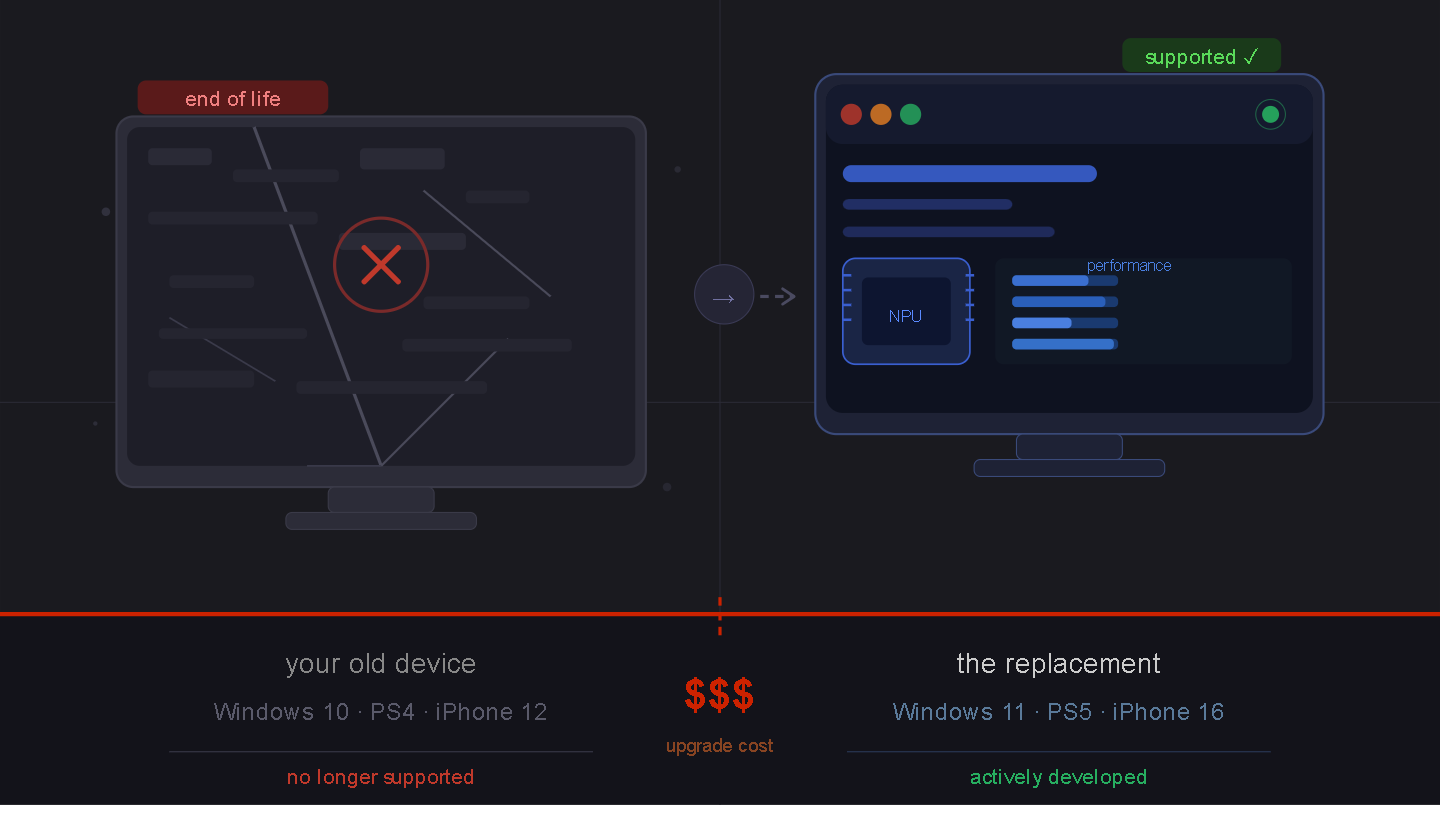
From PlayStation 4 to Windows 10 — millions of devices are being quietly retired every year. The companies say it’s about moving forward. Critics say it’s about moving product.
Every few years, a notification pops up that nobody wants to see. “Your device will no longer receive updates.” Or maybe your favorite online game quietly loses its servers. Or a software feature you rely on just… stops working. The message is always delivered politely, buried in a press release or a support page update. But the meaning is the same: your device has been retired.
It happens with PlayStation consoles, Windows PCs, iPhones, and Android phones. It happens to cars with software dashboards and smart TVs that are barely five years old. And while the companies behind these decisions usually frame it as technical progress, the reality is more complicated — and more expensive for the people on the receiving end.
THE ENGINEERING REALITY
To be fair, there are genuine technical reasons why companies pull the plug on old hardware.
Software never sits still. Every year it grows larger, more demanding, and more complex. Security patches alone require significant engineering resources — and patching a ten-year-old system that was never designed with today’s threats in mind is not a simple task. It can mean rewriting core components from scratch, which costs time and money that companies would rather spend elsewhere.
Microsoft’s decision to end support for Windows 10 in October 2025 is a good example. The operating system ran on hardware that in some cases dated back to 2012. Keeping it secure against modern cyberattacks while simultaneously building Windows 11 and its AI-integrated features became, according to Microsoft, unsustainable. The company argued it was not abandoning users — it was protecting them by pushing them toward a more secure platform.
Sony made similar noises when it began winding down PlayStation 4 support as the PS5 matured. Processing power, memory limits, and storage speeds on the older console made it genuinely difficult to run newer game engines without significant compromise.
None of that is entirely untrue. But it is also not the whole story.
WHERE BUSINESS STRATEGY ENTERS THE PICTURE
Here is where things get uncomfortable. The decision to drop support for a device rarely happens in a vacuum. It almost always coincides with a new product that the company wants you to buy.
When Apple was caught in 2017 deliberately slowing down older iPhones — a scandal that became known as “batterygate” — the company said it was managing battery degradation to prevent unexpected shutdowns. Technically, that was accurate. But the timing, coming just as new iPhone models were being released, raised questions that Apple never fully answered. The company eventually settled a class action lawsuit for up to $500 million.
And it keeps happening, across every corner of the industry. Gaming console generations are announced, old consoles lose first-party support, and players are funneled toward expensive new hardware. PC makers align their products with Windows hardware requirements that conveniently exclude machines from just a few years prior. It is not always cynical — sometimes new hardware genuinely is required — but the incentive to push consumers toward new purchases is always present, and it always shapes these decisions.
THE HUMAN AND ENVIRONMENTAL COST
What often gets lost in these announcements is the scale of the impact. When Microsoft ended Windows 10 support, an estimated 240 million PCs were potentially headed for landfill — not because they stopped working, but because they could no longer run a supported operating system. Environmental groups called it one of the largest instances of manufactured waste in computing history.
For millions of people, particularly in lower-income households or in parts of the world where hardware upgrades are not financially realistic, a dropped support notice is not just an inconvenience. It is a significant financial hit.
Nobody announces it as e-waste. They call it progress. But the numbers tell a different story. According to the United Nations, the world generated a record 62 million metric tons of electronic waste in 2022 — and that figure has only climbed since. Forced obsolescence, whether genuine or manufactured, is a significant driver of that number.
THE PUSHBACK IS GROWING
Governments and consumer groups are starting to push back. The European Union has introduced right-to-repair legislation that requires manufacturers to provide spare parts and software support for longer periods. Several US states have passed similar laws. The argument is straightforward: if a device still functions, the manufacturer should not be able to render it useless through a software decision.
Some companies have responded. Google has extended Android update guarantees on Pixel devices to seven years. Apple has quietly begun offering security patches for older iOS versions even after dropping full support. These are not acts of charity — they are responses to regulatory pressure and consumer backlash.
The open-source community has long offered an alternative. Linux distributions like Ubuntu and Mint regularly breathe new life into hardware that Windows has abandoned. Custom firmware projects keep old routers, phones, and consoles running well past their official end-of-life dates. The devices work fine. They just need software that someone is willing to maintain.
A MIDDLE GROUND EXISTS — COMPANIES JUST NEED TO CHOOSE IT
Look, some obsolescence is genuinely unavoidable. A PlayStation 4 will never run a game engine built for the PS5, just as a phone from 2015 cannot run the AI features being baked into 2026 software. Progress has a hardware cost, and that is a legitimate engineering reality.
But ending all security support, killing online servers, and blocking software updates on devices that are otherwise fully functional is a choice — not a technical inevitability. The question is whether companies will make that choice differently when the financial, regulatory, and reputational costs of not doing so continue to rise.
Right now, the answer is: reluctantly, and only when pushed.