10+ GW
SMR capacity signed by Meta, Amazon, Google
0
Commercial SMRs under construction in the US
4.4% → 12%
US electricity used by data centers, 2023 vs. 2028 est.
2030
Earliest year a flagship deal expects power
Key Takeaways
• Meta, Amazon, and Google have signed deals covering roughly 9.8 to 11.7 GW of small modular reactor (SMR) capacity, depending on how storage capacity and expansion options are counted, mostly aimed at the 2030s.
• No commercial SMR is currently under construction in the US. The only one under construction in North America is in Ontario, Canada.
• One demonstration reactor, Kairos Power’s Hermes, is under construction in Tennessee. It doesn’t produce grid power and isn’t the reactor tied to Google’s deal.
• Data centers used 4.4% of US electricity in 2023. The Department of Energy expects that to reach 6.7% to 12% by 2028, years before most SMR deals are set to deliver power.
• The last major US SMR project, run by NuScale, was cancelled in 2023 after its costs roughly doubled.
What an SMR Actually Is
A small modular reactor, or SMR, is a nuclear reactor built mostly in a factory, in standardized pieces, then shipped and assembled on site. That’s different from a traditional nuclear plant, which is built piece by piece on location over many years.
The pitch is simple: factory parts should be cheaper and faster to build than one-off construction. The economics have not yet been proven at commercial scale in the United States. Every SMR discussed in this piece is still in development, testing, or early construction.
It’s also worth separating SMRs from a different kind of deal: restarting or buying power from an existing large reactor. Microsoft’s plan to restart Three Mile Island’s Unit 1 is real, and it will produce power. But it’s not a small modular reactor. It’s an old, large plant coming back online.
The Deals, Company by Company
Here’s what each company has actually signed, based on public statements and reporting:
| Company | SMR Partner(s) | Committed Capacity | Target Timeline |
|---|---|---|---|
| Meta | Oklo, TerraPower | 1.2 GW (Oklo) + 2.8 GW baseload, up to 4 GW with Natrium’s built-in storage (TerraPower) | TerraPower’s first units as early as 2032 |
| Amazon | X-energy, Energy Northwest | 5+ GW (X-energy); 320 MW, expandable to 960 MW (Energy Northwest) | By 2039 |
| Kairos Power | 500 MW | First reactor by 2030 |
Here’s how that adds up. Using each company’s baseload figures, the most conservative reading, Oklo’s 1.2 GW plus TerraPower’s 2.8 GW gives Meta roughly 4 GW. Add X-energy’s 5+ GW and Energy Northwest’s 320 MW for Amazon, and Kairos’s 500 MW for Google, and the total comes to around 9.8 GW, just under the 10 GW mark.
Two things push that number past 10 GW. TerraPower’s Natrium design has a built-in energy storage system that can boost its output to as much as 4 GW, not 2.8 GW. And Amazon has the option to expand its Energy Northwest project from 320 MW to 960 MW. Count those upper bounds instead of the conservative ones, and the total reaches roughly 11.7 GW.
So “over 10 GW” is a fair description, but it depends on which version of each deal you count, baseload or peak, current commitment or expansion option, and it blends a few different deal types: direct equity investments, long-term power-purchase agreements, and procurement targets that aren’t all equally firm. One figure that’s now out of date: an earlier, widely cited “6.6 GW by 2035” total for Meta. That number combined Meta’s SMR investments with a separate deal to buy power from an existing Vistra plant, and it predates TerraPower’s larger January 2026 agreement, so it no longer reflects the current numbers.
What about Microsoft?
Microsoft isn’t in the table above because its major nuclear commitment, restarting Three Mile Island’s Unit 1, isn’t a small modular reactor. It’s a 835 MW conventional plant coming back online, targeting a restart in 2027–2028. Microsoft has also invested in X-energy, but hasn’t disclosed an SMR-specific capacity figure comparable to its peers.
What “Under Construction” Actually Means
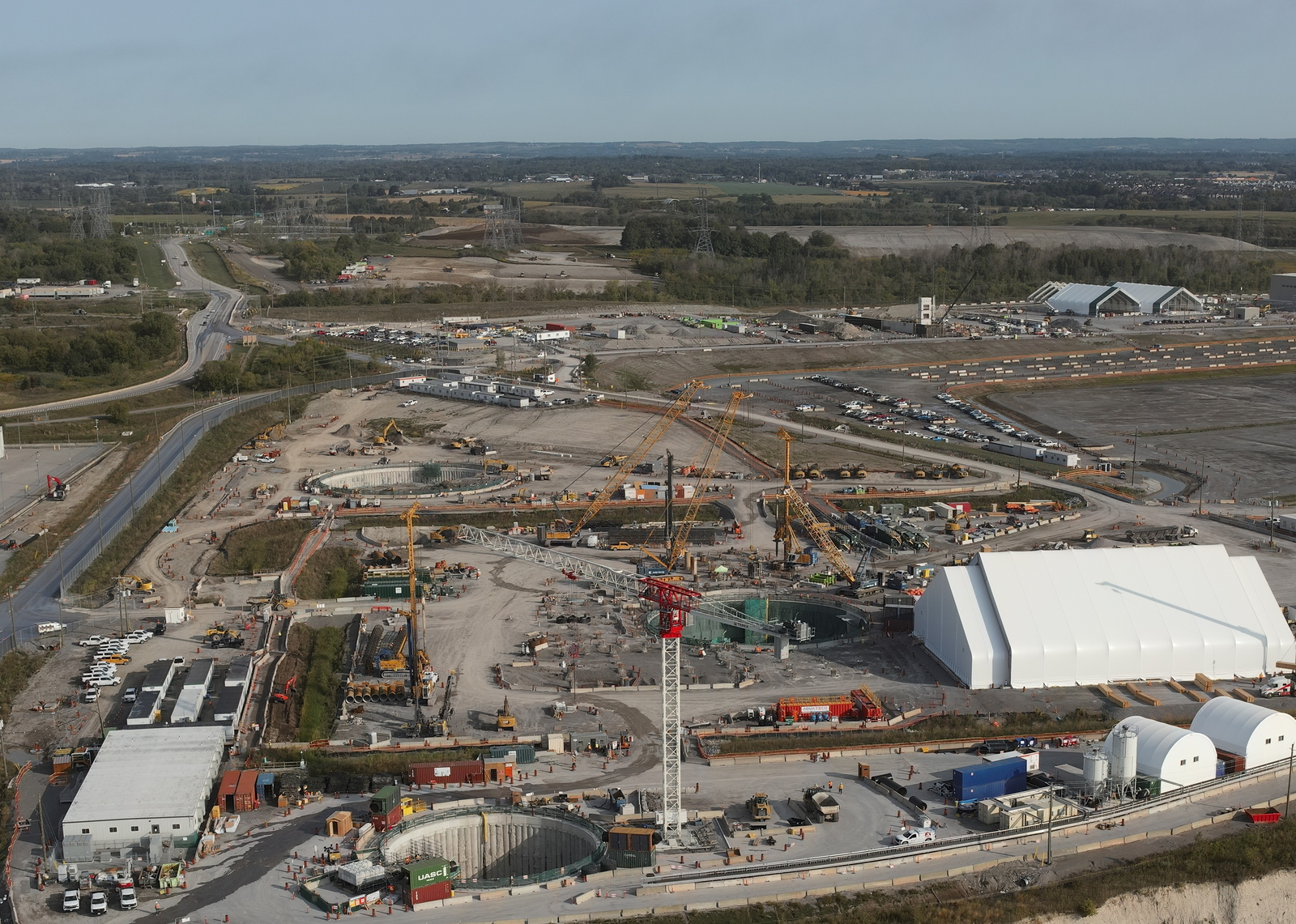
Despite all that committed capacity, legal analysts writing in the American Bar Association’s environmental law publication noted in early 2026 that there is currently only one commercial SMR under construction in North America. It’s not in the US. It’s Ontario Power Generation’s BWRX-300 project at Darlington, Canada.
That project got its construction license in April 2025. Crews have been pouring foundations since. It’s targeting completion by the end of 2029 and commercial power by the end of 2030.
A wrinkle worth knowing: Hermes
Kairos Power, Google’s SMR partner, is building something in Oak Ridge, Tennessee, right now, called Hermes. It’s a low-power demonstration reactor, meaning it’s built to test the technology, not to sell electricity to a grid or a customer. It’s also not the reactor tied to Google’s actual power deal, which is a separate, future commercial design. Hermes did earn a real regulatory first: it’s the first non-light-water reactor to get construction approval in the US in more than 50 years. That’s meaningful progress. It’s just not a commercial power plant.
Separately, the Department of Energy has been running a pilot program that lets a few experimental reactors reach “criticality,” the point where a nuclear reaction becomes self-sustaining, on federal land, outside the normal licensing path. A couple of small test reactors hit that milestone in 2026. They’re demonstrations too, not power plants supplying an electric grid or a data center.
The Track Record Isn’t Encouraging Yet
This isn’t the industry’s first attempt at a US SMR. NuScale became the first company to get its SMR design certified by the Nuclear Regulatory Commission. Its flagship project, a planned 12-reactor plant for a group of Utah power utilities, was cancelled in 2023 after projected costs roughly doubled.
An earlier design, called mPower, met the same fate in 2017, for the same reason: costs came in far above plan.
None of that guarantees the current wave of deals will fail. But it’s the most direct precedent available, and it points to the same risk every time: getting a design approved is not the hard part. Building it on budget is.
The Power Problem Isn’t Waiting
Meanwhile, the reason for all this urgency isn’t standing still. According to the Department of Energy’s 2024 data center report, US data centers used about 4.4% of the country’s electricity in 2023. The report projects that share could reach somewhere between 6.7% and 12% by 2028.
Google’s Kairos deal targets a first reactor by 2030. Amazon’s X-energy deal targets full buildout by 2039. Even in the best case, the power crunch driven by AI arrives years before most of these reactors are scheduled to switch on.
Why the Bet Might Still Pay Off
None of this means the deals are pointless. There’s a real case for patience.
Modular, factory-built reactors are a genuinely different approach to construction than traditional nuclear plants, and shorter, more standardized builds could avoid the cost overruns that sank NuScale’s project, even if that hasn’t been proven yet.
Kairos’s construction approval for Hermes really is the first of its kind in the US in over 50 years, a sign the regulatory process is moving again after decades of near-total stall.
And spreading bets across several developers, Oklo, TerraPower, X-energy, and Kairos, means one company’s failure doesn’t necessarily sink the whole effort. As one industry analyst put it to Reuters, Big Tech’s balance sheets bring a kind of revenue certainty to reactor financing that the industry’s traditional utility-rate-base model never offered.
Ludicarc’s Take
VERDICT
The “over 10 GW” figure is real, but only at the generous end of the range, around 11.7 GW counting storage capacity and expansion options, versus about 9.8 GW on a more conservative baseload count. Either way, it describes signed commitments, not installed capacity: a mix of equity stakes, long-term purchase agreements, and targets, not megawatts already flowing into a grid.
The claim that “no SMR is under construction in the US” is close to true for commercial, power-producing reactors, but not perfectly clean. A demonstration reactor is under construction in Tennessee, and a couple of test reactors reached criticality on federal land this year, through a different regulatory path. None of them are selling power to anyone yet.
The honest read: Big Tech has bought years of optionality on a technology that hasn’t proven itself commercially in the US, while the electricity it actually needs for AI is due well before most of these reactors are scheduled to turn on.
SOURCES
• American Bar Association, “Pressure to Succeed: Small Modular (Nuclear) Reactor Approvals on the Horizon?”, March/April 2026
• GE Vernova, construction update on the Darlington BWRX-300 project
• Nuclear News (American Nuclear Society), “Kairos Power finalizes contract on HALEU for Hermes”, January 2026
• Reuters, “Big Tech puts financial heft behind next-gen nuclear power as AI demand surges”, April 2026
• TerraPower, “TerraPower and Meta Enter Agreement for 8 Natrium Advanced Nuclear Plants”, January 2026 (primary source for the 2.8–4 GW figure)
• Latitude Media, “Meta strikes 6.6 GW nuclear deal to fuel its AI supercluster” (earlier, now-superseded figure)
• U.S. Department of Energy / Lawrence Berkeley National Laboratory, 2024 Report on U.S. Data Center Energy Use, December 2024
• World Nuclear News, reporting on OPG’s Darlington SMR selection and timeline