Fortnite, Roblox, Discord — the metaverse arrived quietly without Meta
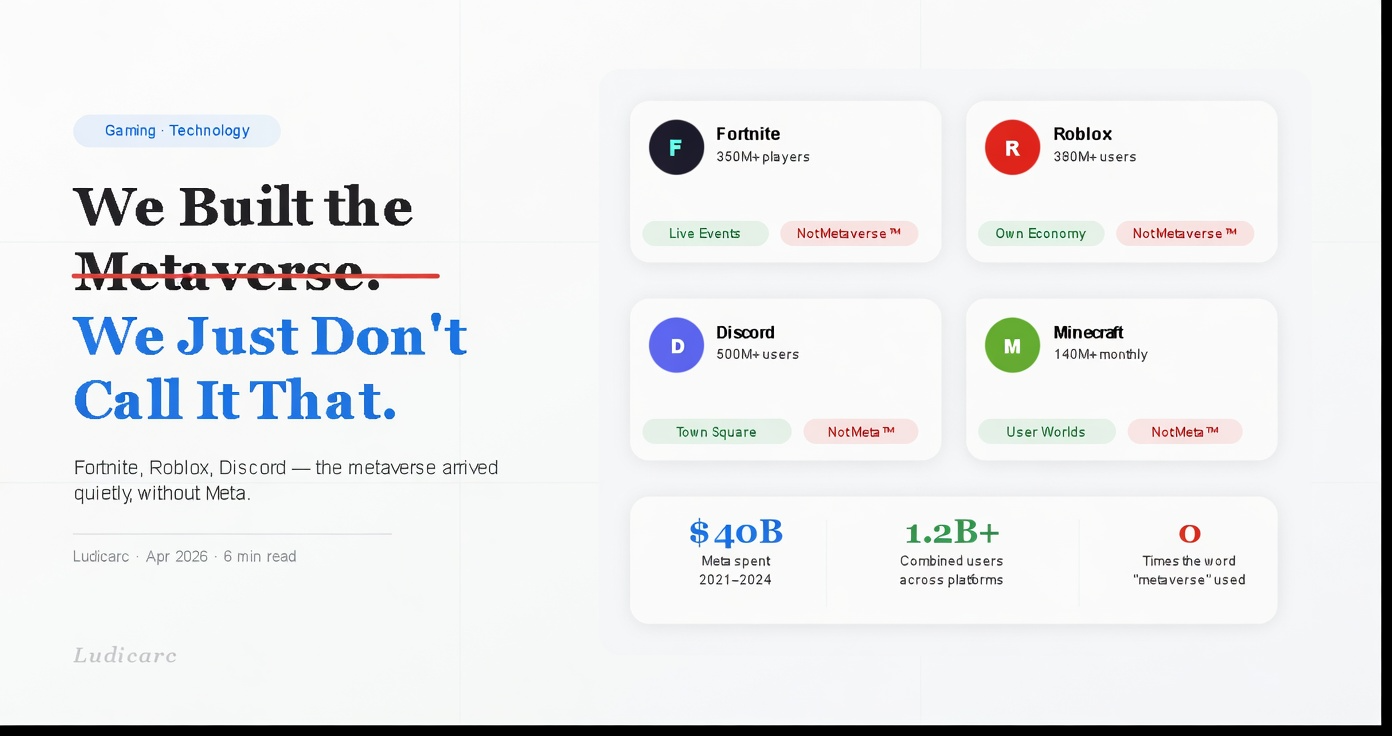
380M+
Registered Roblox users as of 2025
$40B
Meta spent on the metaverse between 2021–2024
500M+
Discord registered users globally
The word that killed the idea
In late 2021, Mark Zuckerberg renamed Facebook to Meta, released a video of his legless avatar floating in a virtual conference room, and declared that the metaverse was the future of human connection. By 2024, the joke had written itself. Horizon Worlds never broke five million monthly active users. The headsets were expensive and uncomfortable. The avatars still had no legs.
But here’s what nobody talks about: while Meta was failing publicly and expensively, the metaverse was being built anyway. Not by a trillion-dollar company with a press release and a rebrand. By a game about building blocks, a battle royale with a concert stage, and a voice chat app that became the internet’s town square.
What the metaverse actually is
Strip away the buzzword and the metaverse has a simple definition: a persistent, shared virtual space where people gather, interact, create, and spend real time doing things that matter to them. That’s it. No VR headset required. No blockchain. No avatar with legs optional.
By that definition, Roblox has been the metaverse for over a decade. It has its own economy — developers earned over $700 million through its platform in 2023. It has its own culture, its own celebrities, its own events. Children don’t think of it as a game. They think of it as a place. That distinction is everything.
The metaverse didn’t fail. The pitch failed. The thing itself arrived years ago and hundreds of millions of people are already living in it.
Fortnite’s quiet evolution
Fortnite launched in 2017 as a battle royale. It is no longer, in any meaningful sense, just a battle royale. Epic Games has turned it into something closer to a platform — a persistent world with a rotating cast of branded experiences, live events, and creative modes where users build and publish their own spaces. Travis Scott performed there in 2020 to an audience of 12 million concurrent viewers. That wasn’t a game event. That was a concert that happened to exist inside a game engine.
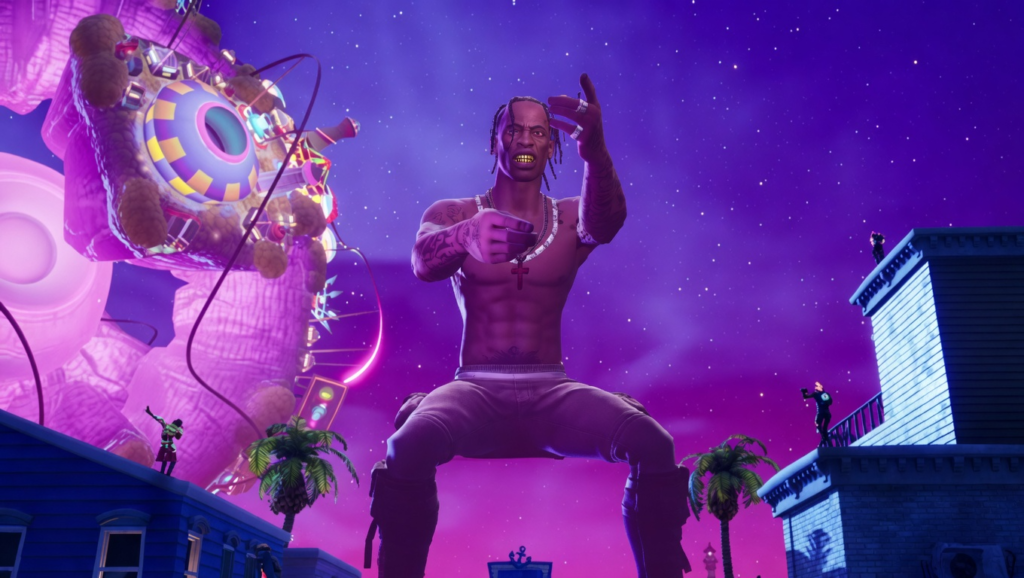
The Fortnite world now contains licensed intellectual property from Marvel, Star Wars, and dozens of other franchises. Players don’t just play — they hang out, they show off skins, they attend events. The battle royale is almost incidental to what the product has become.
Platform by platform
| Platform | Metaverse function | What Meta tried |
|---|---|---|
| Roblox | Persistent world, own economy, social identity | Horizon Worlds — same idea, fraction of the users |
| Fortnite | Live events, branded spaces, creative publishing | Horizon Venues — virtual concerts nobody attended |
| Discord | Community infrastructure, persistent social layer | No equivalent — Meta never built this |
| Minecraft | User-generated worlds, education, cultural preservation | Attempted VR integration — quietly shelved |
Discord — the metaverse’s nervous system
Discord is the part of this story that gets the least credit. It isn’t a game. It isn’t a virtual world. But it is the connective tissue that makes all of it work. Communities form on Discord around games, around content creators, around shared interests that have nothing to do with gaming at all. Servers function like neighbourhoods — persistent, organised, with their own cultures and hierarchies and inside jokes that develop over years.
Discord has over 500 million registered users. Most of them are not gamers in any traditional sense. They’re people who found that Discord’s infrastructure — voice channels, text channels, roles, bots, threads — gave them a better way to organise community than anything else available. That is, almost precisely, what the metaverse was supposed to be.
Discord built the town square. Roblox built the economy. Fortnite built the stadium. Meta built the press release.
Why Meta got it wrong
Meta’s failure wasn’t technological — it was philosophical. Zuckerberg assumed the metaverse needed to be announced, designed, and sold as a destination. What actually happened is that the metaverse emerged organically from platforms people already loved, built by developers responding to what users actually wanted, one feature at a time.
The other mistake was hardware. Meta bet heavily on VR headsets as the entry point, which priced out most of the world and added friction to something that needed to be frictionless. Roblox runs on an old iPad. Fortnite runs on a phone. Discord runs in a browser tab. The real metaverse was always going to be wherever people already were, not somewhere they had to buy a $500 device to reach.
Where it goes from here
The next evolution of these platforms is already visible. Roblox is expanding its developer economy and pushing into education. Epic is licensing its Unreal Engine to create shared virtual infrastructure across industries. Discord is becoming a platform in its own right, not just a utility. And AI-generated content is about to make user-created worlds dramatically easier to build and scale.
None of this will be called the metaverse. The word is too damaged, too associated with legless avatars and boardroom announcements and $40 billion in write-offs. But the thing itself — persistent, shared, social virtual space where real culture forms and real value is created — that’s not a vision anymore. It’s already here. It’s just wearing different clothes.