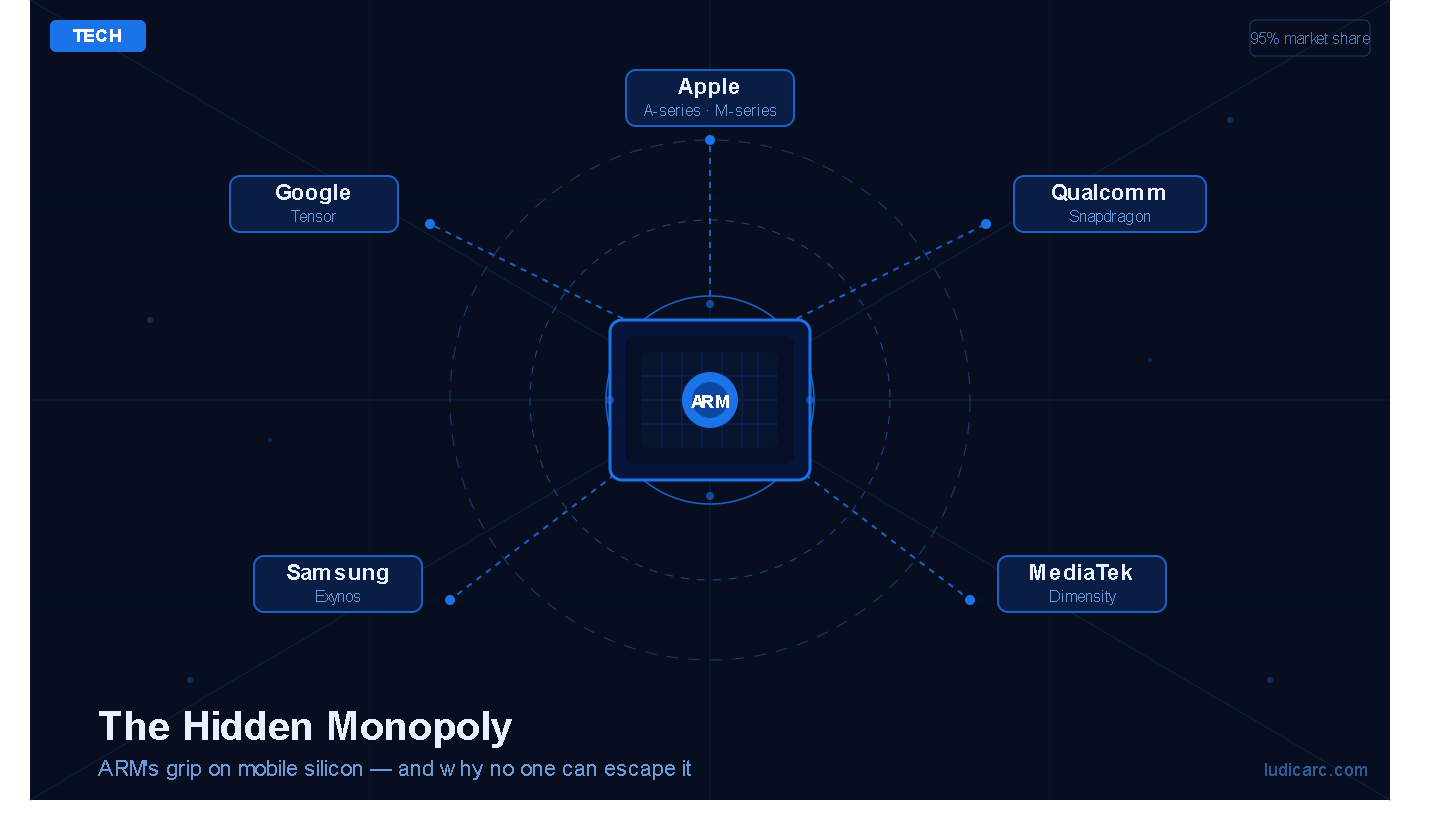
ARM’s grip on mobile silicon and why no one can escape it.
95%+
Of smartphones worldwide run ARM-based chips
2016
SoftBank acquired ARM for $32 billion
2023
ARM went public after NVIDIA deal was blocked
You’ve probably heard of Qualcomm, Apple, Samsung, and MediaTek. These are the companies whose chips power the phones in our pockets. But there’s another name behind all of them — one that most people have never thought about — and it quietly controls the engine at the heart of almost every smartphone on the planet. That name is ARM.
A company that sells ideas, not chips
ARM Holdings doesn’t actually manufacture anything. No factories, no assembly lines, no physical products leaving a warehouse. What ARM sells is something far more powerful: the blueprint for how a processor should work.
Think of it like a master architect who draws the perfect building design and then licenses it out to dozens of construction companies. Each company builds its own version of the building, customizes the interior, and sells it under their own name. But the fundamental design? That came from one place.
That’s exactly what ARM does with chip architecture. When Qualcomm designs a Snapdragon chip, or when Apple creates an A-series processor, they’re both working from ARM’s instruction set — the foundational language that tells the chip how to process information. They customize heavily on top of it, but the core is ARM. And this isn’t a niche arrangement. ARM-based chips are inside over 95% of the world’s smartphones.
Why did ARM win so completely?
The short answer is power efficiency. The smartphone era demanded something that traditional desktop chips couldn’t deliver: a processor powerful enough to run real software, but efficient enough not to drain a small battery in two hours. Intel, which dominated the PC world, was built for raw performance at any cost. ARM was built to do more with less.
ARM’s architecture uses what’s called a RISC design — Reduced Instruction Set Computing. It uses a smaller set of simpler instructions to get work done, making it faster to execute tasks and much easier on battery life.
When smartphones exploded in popularity in the late 2000s, ARM was already perfectly positioned. They had been quietly building this reputation in embedded systems and feature phones for years. When Apple chose ARM for the original iPhone, it wasn’t a bold experiment — it was a logical choice. Everyone else followed.
Can anyone actually escape it?
This is where things get interesting — and a little complicated. RISC-V is an open-source chip architecture that has been gaining momentum as a genuine alternative to ARM. Unlike ARM’s licensed model, RISC-V is free to use, modify, and build on. Companies like Google, Samsung, and even some Chinese tech giants have been investing heavily in RISC-V development.
On paper, it sounds like the perfect escape route. In practice, it’s not that simple. ARM’s dominance isn’t just technical — it’s an ecosystem. Decades of software, tools, developer knowledge, and hardware libraries are all optimized for ARM. If a company switches to RISC-V, they don’t just need a new chip design. They need new compilers, new software optimization, new toolchains, and they have to convince app developers and operating system teams to care about it.
RISC-V
Open-source alternative. Free to use, modify and build on. Google, Samsung investing heavily — but ecosystem is decades behind ARM.
Qualcomm / Nuvia
After acquiring Nuvia, Qualcomm is developing custom CPU cores that push further beyond ARM’s reference designs than ever before.
Apple Silicon
M-series chips in Macs redefined what laptops can do. Apple owns the implementation — but the architecture underneath is still ARM.
China
US-China chip tensions make ARM licenses a geopolitical weapon. Chinese firms are actively exploring RISC-V to reduce exposure.
Apple has shown what’s possible when a company commits fully to its own silicon vision — but even Apple is using ARM. They own the implementation, not the architecture underneath.
Why this should matter to you
You might be wondering why any of this matters if your phone works fine. But ARM’s stranglehold on mobile silicon has real consequences. It creates a single point of fragility in the global tech supply chain.
When NVIDIA attempted to purchase ARM in 2020, regulators around the world blocked the deal specifically because they recognized how dangerous it would be to let one chipmaker control the architecture everyone else depends on. The concern hasn’t gone away — ARM went public in 2023 instead, but the structural risk remains.
There’s also the question of geopolitics. ARM is a British company, subject to export controls that have direct implications in the US-China chip war. When ARM restricts or limits its licenses, entire national tech industries feel the tremor.
The blueprint nobody talks about
What makes ARM’s position so remarkable is how invisible it is to most people. We talk about the chips by their brand names. We debate iPhone versus Android. We argue over benchmark scores and camera quality. But underneath all of it, quietly holding the whole thing together, is a company most people couldn’t pick out of a lineup.
That’s the real monopoly — not one enforced by market aggression, but one built so deeply into the foundation of modern technology that there’s genuinely no easy way around it.
Next time you pick up your phone, somewhere inside it is a tiny piece of ARM’s DNA. And it’s been there since the beginning.