AI powered upscaling has become an essential technology in modern gaming. As native 4K rendering grows increasingly demanding even for the most powerful flagship GPUs solutions like NVIDIA’s DLSS 4.5 and AMD’s FSR 4 now play a decisive role in delivering high-resolution gameplay with acceptable performance.
Both technologies have evolved significantly beyond simple upscaling. In 2026, they focus heavily on temporal stability, artifact reduction, ray tracing efficiency, and overall visual fidelity. This comparison examines their real-world performance and image quality across several graphically demanding 2026 titles.
Test Methodology
Test System
CPU: Intel Core i9-14900K
NVIDIA GPU: GeForce RTX 4090
AMD GPU: Radeon RX 7900 XTX
Memory: 32 GB DDR5 @ 7200 MHz
Display: 4K (3840×2160) 240 Hz HDR monitor
Games Tested
Cyberpunk 2077: Phantom Liberty
Fable: The New Journey
Eclipse
Starfield (Final Update)
Testing Parameters
Output Resolution: 4K
Upscaling Presets: Native TAA vs DLSS Quality vs FSR Quality
Ray Tracing: Maximum settings
Metrics Collected: Average FPS, 1% Lows, and visual stability (ghosting, shimmering, clarity)
Performance Benchmarks
| Game | Native 4K | DLSS 4.5 Quality | FSR 4 Quality | DLSS Uplift | FSR Uplift |
|---|---|---|---|---|---|
| Fable: The New Journey | 61 FPS | 112 FPS | 98 FPS | +84% | +61% |
| Cyberpunk 2077: Phantom Liberty | 53 FPS | 116 FPS | 102 FPS | +119% | +92% |
| Eclipse | 48 FPS | 105 FPS | 89 FPS | +119% | +85% |
| Starfield (Final Update) | 82 FPS | 141 FPS | 129 FPS | +72% | +57% |
Performance Analysis
DLSS 4.5 continues to hold a clear performance advantage, especially in heavily ray-traced scenes. The performance gap over FSR 4 ranged from 10% to 27% depending on the game and scene complexity.
However, the difference is noticeably smaller than in previous generations. AMD has made substantial improvements to FSR’s temporal reconstruction pipeline, allowing it to deliver much closer performance to DLSS than ever before. In less demanding raster-heavy scenes, the gap narrows even further.
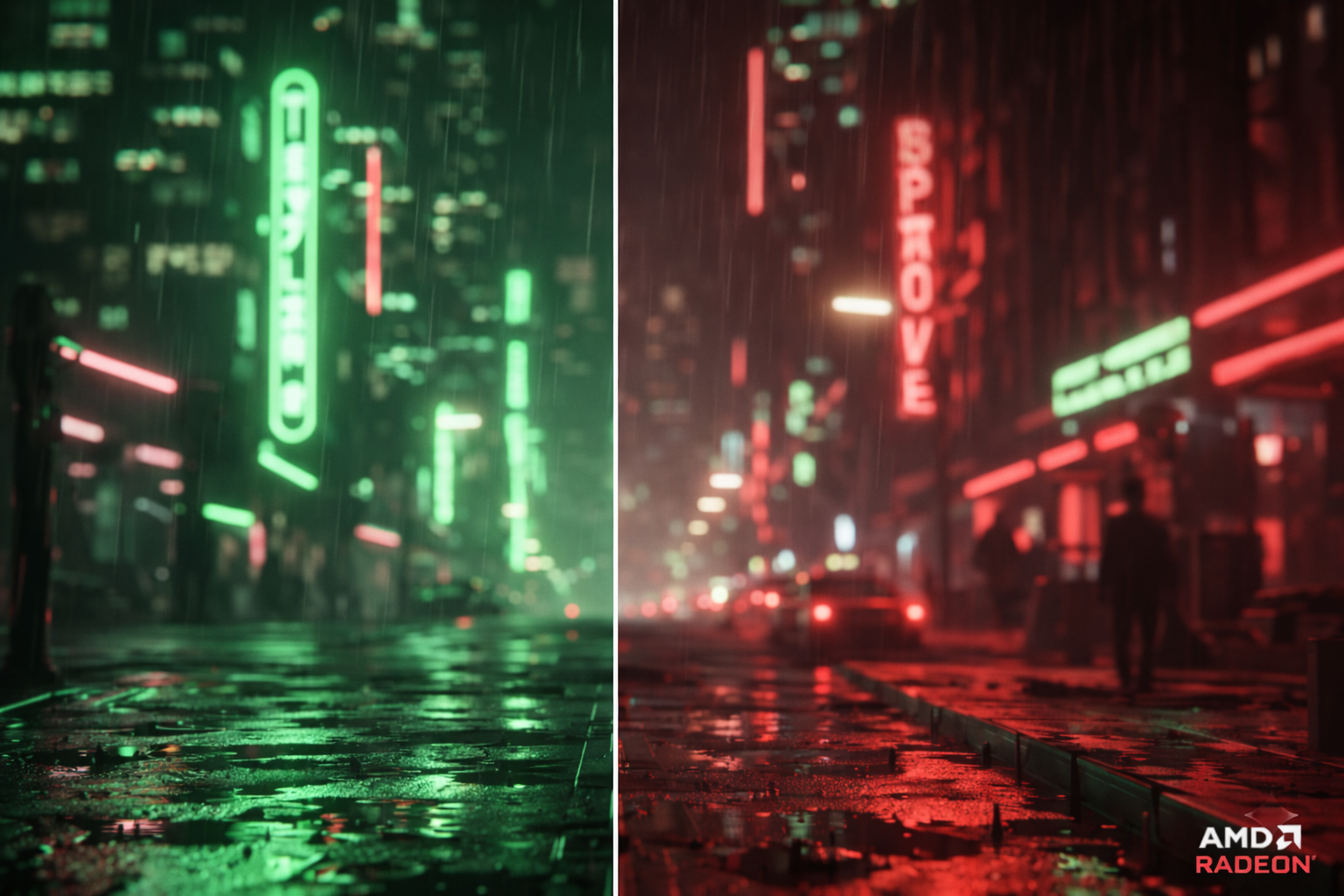
Image Quality Comparison
DLSS 4.5
NVIDIA’s latest version benefits greatly from Ray Reconstruction 2.0, which delivers superior denoising and cleaner ray-traced effects. It offers excellent temporal stability with minimal ghosting and outstanding clarity in reflections and fine details. Motion looks smooth and natural even during fast camera movement.
FSR 4
AMD’s FSR 4 introduces a new Temporal AI model that significantly reduces shimmering and crawling artifacts. In static scenes, image clarity is very close to DLSS 4.5. However, it still shows slight instability during complex ray-traced motion and fast-moving objects compared to its NVIDIA counterpart.
Image Quality Verdict
DLSS 4.5 maintains a narrow but consistent lead in high-frequency temporal detail and ray-traced visual quality. In purely rasterized scenes, the differences are often minimal and subjective. Overall, FSR 4 represents AMD’s strongest upscaling solution to date and is now genuinely competitive in many titles.
Feature Set Comparison
| Feature | DLSS 4.5 | FSR 4 |
|---|---|---|
| Upscaling Quality | Excellent | Excellent |
| Frame Generation | Reflex+ integrated | AFMF+ / Integrated FG |
| Latency Behavior | Superior | Competitive |
| Hardware Requirements | RTX 40 & 50-series exclusive | Cross-vendor (AMD, NVIDIA, Intel) |
| Game Support | Strong AAA adoption | Extensive and open-source friendly |
Who Should Choose Which?
Choose DLSS 4.5 if you:
Own an RTX 40 or 50-series GPU
Prioritize maximum ray tracing performance
Want the best visual stability and lowest latency with Frame Generation
Value the highest possible image quality in demanding titles
Choose FSR 4 if you:
Use a multi-vendor setup (AMD, NVIDIA, or Intel GPUs)
Want broad game compatibility without vendor lock-in
Prefer an open and flexible solution
Seek strong performance gains across a wide range of hardware
Final Thoughts
In 2026, DLSS 4.5 remains the overall leader in both performance and visual stability, particularly when heavy ray tracing is enabled. However, FSR 4 has made remarkable progress and has significantly closed the historical gap that once existed between the two technologies.
The choice between them is becoming less about raw image quality and more about your hardware ecosystem and priorities. NVIDIA users will still benefit most from DLSS 4.5, while AMD users — and those who value flexibility — now have a genuinely strong alternative in FSR 4.
As game developers continue to adopt both technologies more aggressively, upscaling is no longer a “nice-to-have” — it has become fundamental to achieving smooth, high-fidelity 4K gaming in the current generation.