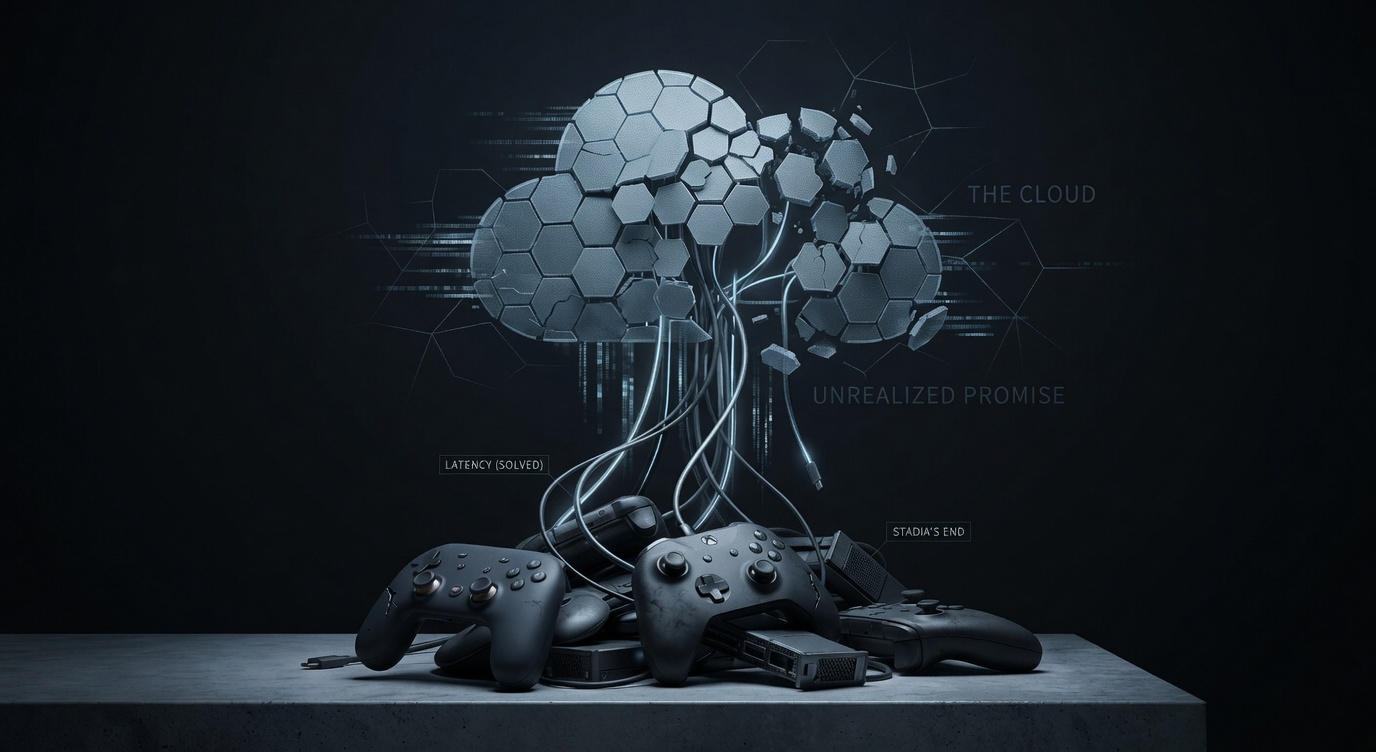
Stadia’s death, xCloud’s stall — why latency isn’t the only problem
2023
Year Google shut Stadia down, just 3 years after launch
$100M+
Estimated spent on Stadia exclusives — most never released
~20ms
Latency needed for cloud gaming to feel acceptable — rarely achieved
It had everything going for it
Think about what Google brought to the table when Stadia launched in 2019. Arguably the most sophisticated cloud infrastructure on the planet. Billions of dollars. A brand that billions of people already trusted. A distribution network — YouTube — that reaches more gamers daily than any console manufacturer ever has. If anyone was going to crack cloud gaming, it really should have been them.
They failed anyway. And not quietly — Stadia shut down in January 2023, less than four years after its debut, with Google refunding hardware purchases and quietly retiring one of the most hyped gaming products in recent memory. The question isn’t just what went wrong with Stadia. It’s why cloud gaming, despite having every structural advantage, keeps running into the same wall.
The timeline of promises
Google Stadia launches. Promises 4K 60fps gaming with no hardware required. Reviews are mixed. Input lag is noticeable. The game library is thin.
Stadia shuts its first-party studios before a single exclusive ships. The signal is clear — Google is already losing interest. Microsoft quietly expands xCloud through Game Pass.
Amazon Luna and NVIDIA GeForce Now try different approaches — Luna bundles, GeForce Now streams your existing library. Neither gains real mainstream traction.
Stadia officially dead. Microsoft’s xCloud still exists but is rarely the headline. The dream of replacing consoles with a browser tab quietly retreats.
Yes, latency is a problem — but it’s not the problem
Every post-mortem on Stadia leads with latency, and fair enough — it was real and it was annoying. When you press a button and the action happens 80 milliseconds later instead of 10, you feel it. In a fast-paced shooter or a fighting game, that gap is the difference between fun and frustrating. Cloud gaming still hasn’t solved this reliably outside of ideal conditions, and ideal conditions — fast fibre, low server distance, quiet network — describe a minority of the global gaming audience.
But here’s the thing: latency is a solvable engineering problem. More edge servers, better compression, smarter buffering. It’s expensive, but it’s not mysterious. What actually killed Stadia — and what continues to stall every cloud platform — is much harder to fix, because it’s not a technical problem at all.
Gamers don’t just want access to games. They want to own them, build libraries, carry saves, and feel like the thing they bought actually belongs to them.
The ownership problem nobody wanted to talk about
When you buy a game on Steam, it’s yours in a way that feels real. It sits in your library. You can reinstall it ten years from now. You can gift it, lend it, play it offline in a cabin with no signal. The purchase has weight. Cloud gaming asks you to abandon all of that and trust a company — often one with a documented history of killing products — to keep your games available indefinitely.
Google killed Stadia. If you’d bought fifty games on that platform, they were gone. Yes, Google refunded the hardware. No, they didn’t give back the hundreds of hours people had invested expecting continuity. That’s not a latency problem. That’s a trust problem, and trust, once broken at scale, is extremely hard to rebuild.
The library problem nobody solved
Even if you trusted the platform, the game selection was never there. Stadia launched with a handful of titles that were already available everywhere else — often cheaper, with better performance — and the exclusives that were supposed to differentiate it never materialised. Why would you pay a subscription for a streaming service with a worse catalogue than the platform you already own?
NVIDIA’s GeForce Now took the opposite approach and let you stream games you already owned on Steam. Smarter — but it created a different problem. Publishers kept pulling their titles from the service, worried about licensing and lost sales. The library was unreliable. You’d add a game to your wishlist and find it gone a month later. Again, not a latency problem. A business model problem.
The console isn’t just a box. It’s a commitment — to a library, a community, a save file that’s actually yours. Cloud gaming never figured out how to replicate that feeling.
So where does that leave us
Cloud gaming isn’t dead — it’s just not what anyone promised it would be. It exists as a useful supplementary feature: playing your Xbox games on your phone while travelling, streaming a PC title to a cheap laptop, testing a game before you commit to downloading 80GB. In that role, it works fine and has a genuine audience.
But the vision — replace your console, your PC, your entire gaming setup with a browser tab — hasn’t arrived and probably won’t for a long time. Not because the technology isn’t good enough, though it still isn’t. But because gaming is one of the few spaces where people have genuinely strong feelings about ownership, continuity, and control. You can stream music and be fine with it. You can stream films and barely notice. But your save file, your library, your settings, your 400-hour RPG — that’s different. That’s yours. And until cloud gaming can convincingly say the same thing, the console in your living room isn’t going anywhere.