Introduction: AI Upscaling in 2026
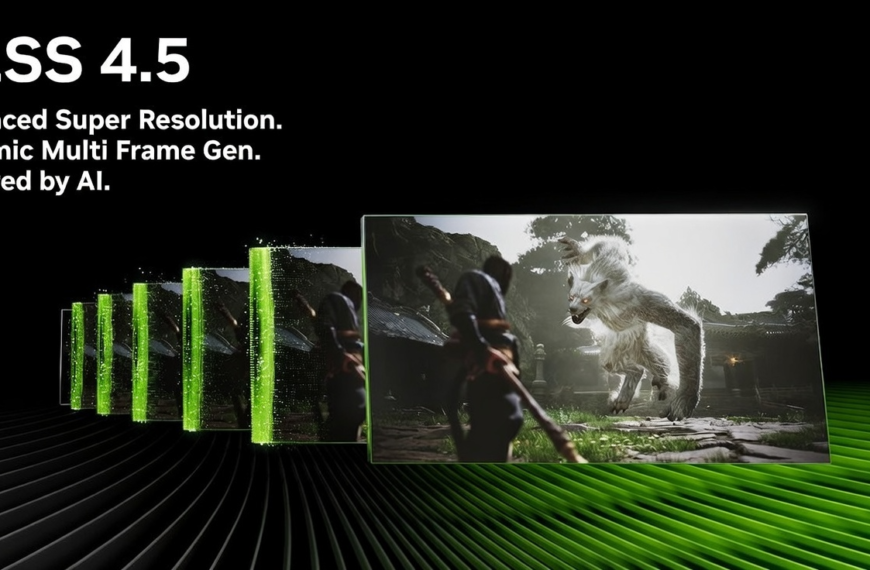
AI-powered upscaling has become central to modern gaming performance. With native 4K rendering increasingly demanding — even for flagship GPUs — technologies like NVIDIA DLSS 4.5 and AMD FSR 4 now define the high-end visual experience.
Both solutions represent more than incremental upgrades. Architectural refinements target not only performance uplift, but temporal stability, artifact reduction, and ray tracing efficiency.
This comparison evaluates real-world behavior across several graphically intensive 2026 titles.
Test Methodology & Hardware
Test System
| Component | Specification |
|---|---|
| CPU | Intel Core i9-14900K |
| GPU (NVIDIA) | GeForce RTX 4090 |
| GPU (AMD) | Radeon RX RX 7900 XTX |
| Memory | 32GB DDR5 @ 7200MHz |
| Display | 4K (3840×2160), 240Hz HDR |
Games Tested
- Cyberpunk 2077: Phantom Liberty
- Fable: The New Journey
- Eclipse
- Starfield (Final Update)
Testing Parameters
- Output Resolution: 4K
- Presets: Native TAA / DLSS Quality / FSR Quality
- Ray Tracing: Maximum
- Metrics: Average FPS / 1% Lows / Visual Stability
Performance Benchmarks
| Game | Native 4K | DLSS 4.5 Quality | FSR 4 Quality | DLSS Uplift | FSR Uplift |
|---|---|---|---|---|---|
| Fable: The New Journey | 61 FPS | 112 FPS | 98 FPS | +84% | +61% |
| Cyberpunk 2077 | 53 FPS | 116 FPS | 102 FPS | +119% | +92% |
| Eclipse | 48 FPS | 105 FPS | 89 FPS | +119% | +85% |
| Starfield | 82 FPS | 141 FPS | 129 FPS | +72% | +57% |
Performance Analysis
DLSS 4.5 maintains a measurable advantage, particularly in ray-traced workloads. Gains ranged from 10% to 27% over FSR 4 depending on scene complexity.
The performance gap narrows compared with prior FSR generations, indicating substantial improvements in AMD’s temporal reconstruction pipeline.
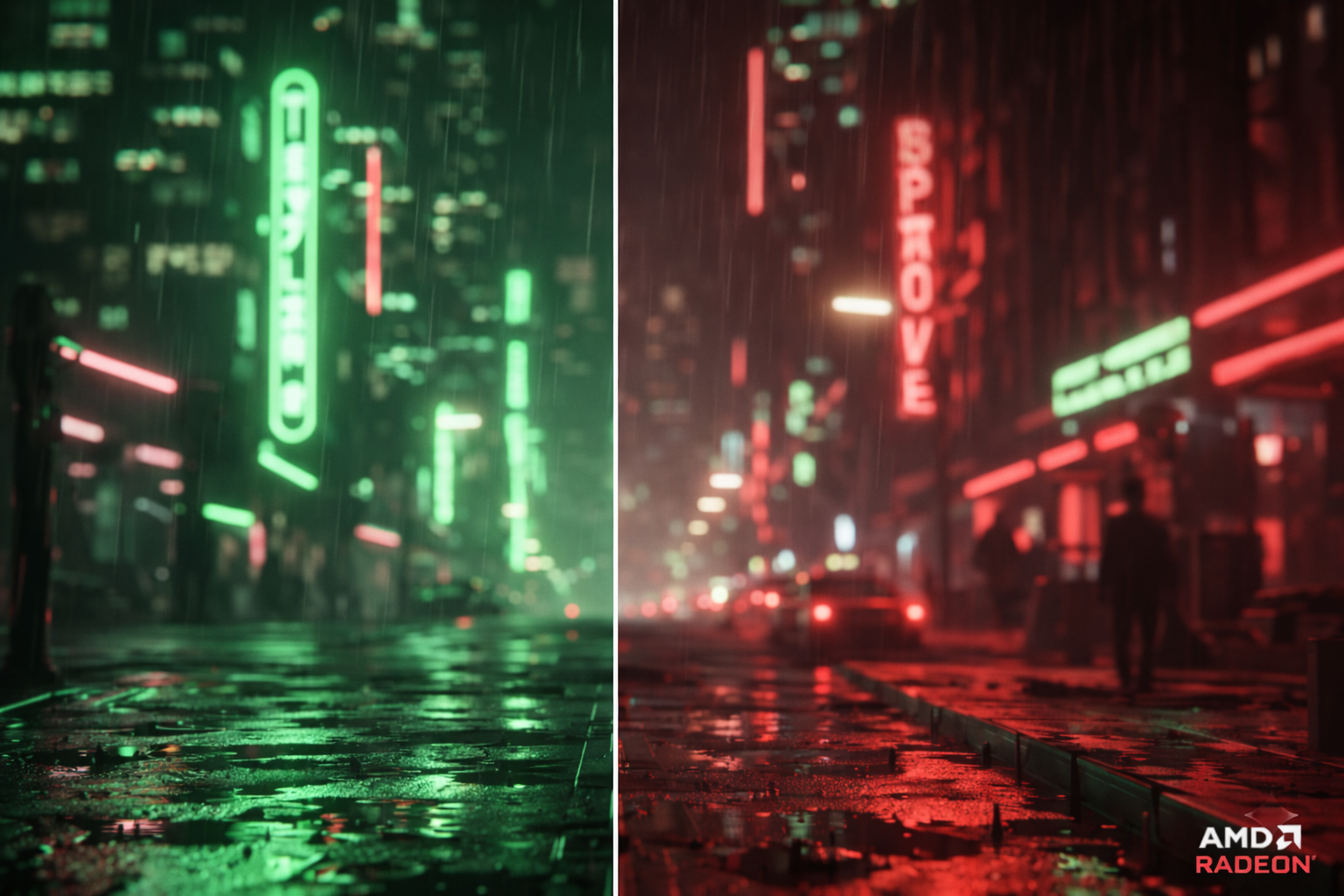
Image Quality Comparison
DLSS 4.5
- Ray Reconstruction 2.0 improves denoising
- Excellent temporal stability
- Minimal ghosting
- High clarity in RT reflections
FSR 4
- New Temporal AI model
- Major reduction in shimmer artifacts
- Static clarity near DLSS parity
- Slight instability in complex RT motion
Image Quality Verdict
DLSS 4.5 retains a narrow lead in high-frequency temporal detail, especially under heavy ray tracing. In traditional rasterized scenes, differences are minimal.
FSR 4 represents AMD’s most competitive visual output to date.
Feature Set Comparison
| Feature | DLSS 4.5 | FSR 4 |
|---|---|---|
| Upscaling Quality | Excellent | Excellent |
| Frame Generation | Reflex+ integrated | AFMF+ / Integrated FG |
| Latency Behavior | Superior | Competitive |
| Hardware Scope | RTX-exclusive | Cross-vendor |
| Game Support | Broad AAA adoption | Extensive & open |
The Bottom Line
DLSS 4.5 Best For
- RTX 40 / 50-series users
- Maximum RT performance
- Lowest latency frame generation
- Visual stability priority
FSR 4 Best For
- Multi-vendor GPU setups
- Broad game compatibility
- Vendor-agnostic workflows
- Strong performance gains without lock-in
Final Thoughts
DLSS 4.5 remains the performance and stability leader, particularly in ray-traced scenarios. FSR 4, however, significantly closes historical gaps, offering a compelling alternative with broad compatibility.
The decision increasingly depends on hardware ecosystem rather than outright image quality differences.