
In January 2026, artificial intelligence is entering a new phase. Agentic AI is no longer just hype—it’s delivering real-world results. These systems go far beyond traditional chatbots. They can plan ahead, reason through problems, use external tools, and carry out complex, multi-step tasks with very little human involvement.
Instead of responding to single prompts, agentic systems operate with goals in mind. They decide what needs to be done, how to do it, and when to act—making them far more autonomous than earlier AI models.
How Multi-Agent Workflows Actually Work
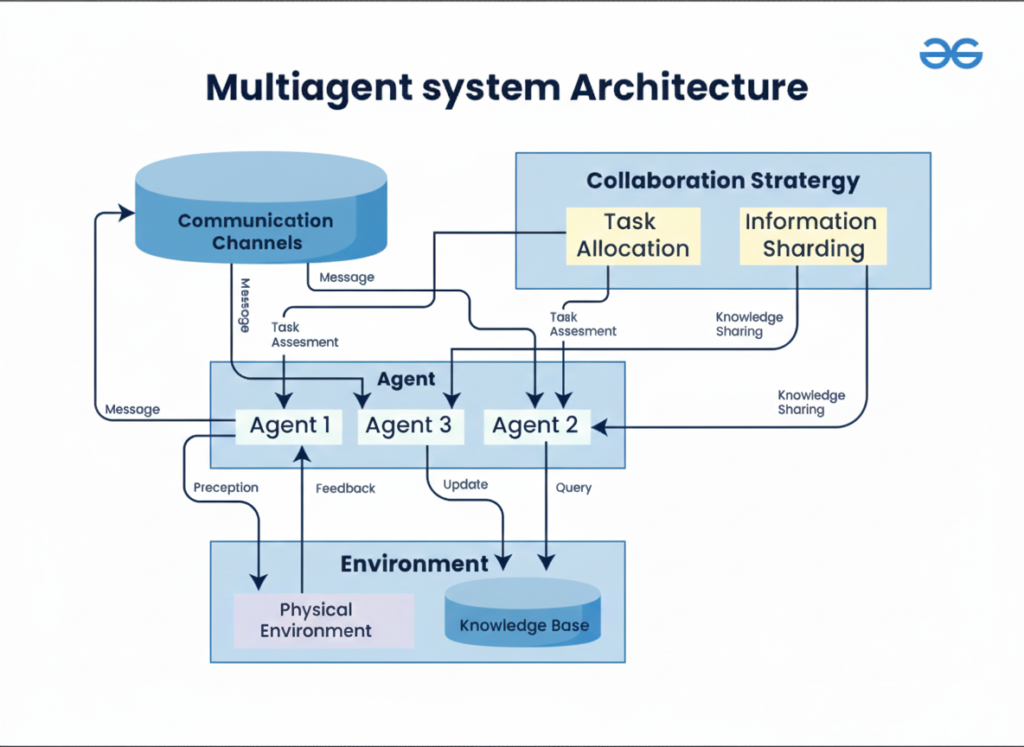
At the heart of this shift are multi-agent workflows, where multiple AI agents work together like a coordinated digital team. Each agent has a specialized role, allowing the system to tackle complex operations efficiently.
For example, one agent may continuously monitor inventory levels, another might handle supplier negotiations, while a third optimizes logistics and delivery routes. These agents communicate and coordinate in real time, sharing data and adjusting their actions as conditions change—all without constant human oversight.
This collaborative approach makes agentic AI especially powerful for businesses, logistics, finance, operations, and large-scale automation.
Visualizing Multi-Agent Architectures
To better understand how these systems are built and deployed, visual diagrams are essential. They show how agents connect, share information, and make decisions together across different layers of an organization or platform.
Here are some visuals of how these multi-agent systems are architected and deployed:
According to Gartner, by the end of 2026, nearly 40% of enterprise applications will integrate task-specific AI agents—a massive jump from less than 5% in 2025. This rapid adoption highlights how quickly agentic AI is moving from experimentation to core business infrastructure.
The market reflects this momentum. Analysts project the agentic AI systems market to surge toward $50+ billion by 2030, driven by enterprises seeking automation that goes beyond simple scripts and rules.
Transforming Key Industries
Manufacturing
In manufacturing, agentic AI is reshaping how production lines operate. Autonomous agents monitor equipment for early signs of failure, enabling predictive maintenance before breakdowns occur. Quality inspections are increasingly automated, with agents detecting defects in real time and flagging issues instantly.
These systems can also reorder materials on their own and dynamically adjust schedules when disruptions happen. The result is reduced downtime, higher throughput, and improved overall efficiency without constant human intervention.
Logistics & Supply Chain
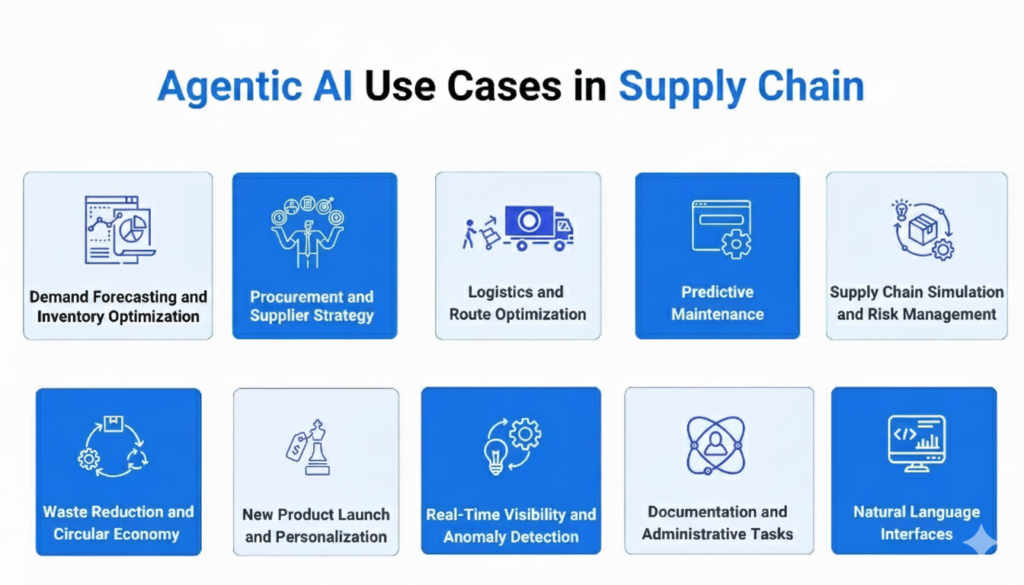
Logistics and supply chains are where agentic AI delivers some of its most dramatic results. Here, multiple agents coordinate entire workflows from start to finish. They forecast demand, reroute shipments during delays, identify alternative suppliers when shortages occur, and update delivery times across connected platforms automatically.
Early adopters report up to a 40% reduction in delays, along with significant cost savings and improved reliability. By reacting instantly to changing conditions, these systems keep operations moving smoothly—even in highly volatile environments.
Agentic AI in Action
To truly understand the impact, it helps to see how these agents operate within real supply chain environments—how they communicate, make decisions, and adapt in real time.
Take a closer look at agentic AI in action within supply chains:
Enterprise Applications: A New Digital Workforce
Across enterprise applications—from finance to human resources—agentic AI systems are now managing composite, end-to-end workflows. Instead of handling isolated tasks, autonomous agents resolve entire customer issues by coordinating across billing, entitlements, and logistics in a single, continuous process.
A key breakthrough is the rise of self-verifying agents. These systems don’t just act—they explain why they act. By tracing their logic, providing auditable reasoning, and operating within built-in compliance guardrails, agentic AI is evolving into a trustworthy digital workforce that enterprises can rely on for mission-critical operations.
The Road Ahead: Trust and Governance
In 2026, progress in agentic AI is no longer defined solely by raw capability. Trustworthy autonomy has become the real benchmark. Organizations are adopting bounded autonomy models, where agents operate freely within clearly defined limits, reducing risk while preserving flexibility.
New governance agents are also emerging—AI systems designed to monitor, audit, and guide other agents in real time. For high-stakes decisions, human-in-the-loop controls remain essential, ensuring accountability and ethical oversight when outcomes truly matter.
Rather than layering AI onto outdated workflows, leading organizations are redesigning processes from the ground up, enabling agentic systems to function as first-class participants in operations rather than add-ons.
Augmentation, Not Replacement
The message is increasingly clear: agentic AI is not replacing humans—it’s augmenting them. By delegating complexity and execution to autonomous agents, human teams gain the freedom to focus on strategy, creativity, and judgment.
As multi-agent systems mature and open protocols like MCP and A2A enable seamless collaboration between agents, 2026 is shaping up to be the year enterprises transform into living networks of intelligent, adaptive processes.