For years, quantum computing has lived in the comfortable space of "someday." That someday is beginning to arrive — not with a bang, but with something more durable: measurable, real-world progress.
There’s a particular kind of hype cycle that surrounds transformative technologies. We saw it with artificial intelligence, with blockchain, with gene editing. Quantum computing has been no different — breathless headlines, venture capital pouring in, and promises of machines that would render all previous computers obsolete overnight.
But something has shifted recently. The researchers and engineers who actually build these machines are talking less about what quantum computers will do and more about what they are doing. The language has moved from revolution to refinement. And that, counterintuitively, is a very good sign.
First, What Exactly Is a Quantum Computer?
Classical computers — the laptops, phones, and data center servers we use every day — store and process information as bits. A bit is either a 0 or a 1. It’s binary, deterministic, and it underpins essentially all modern computing.
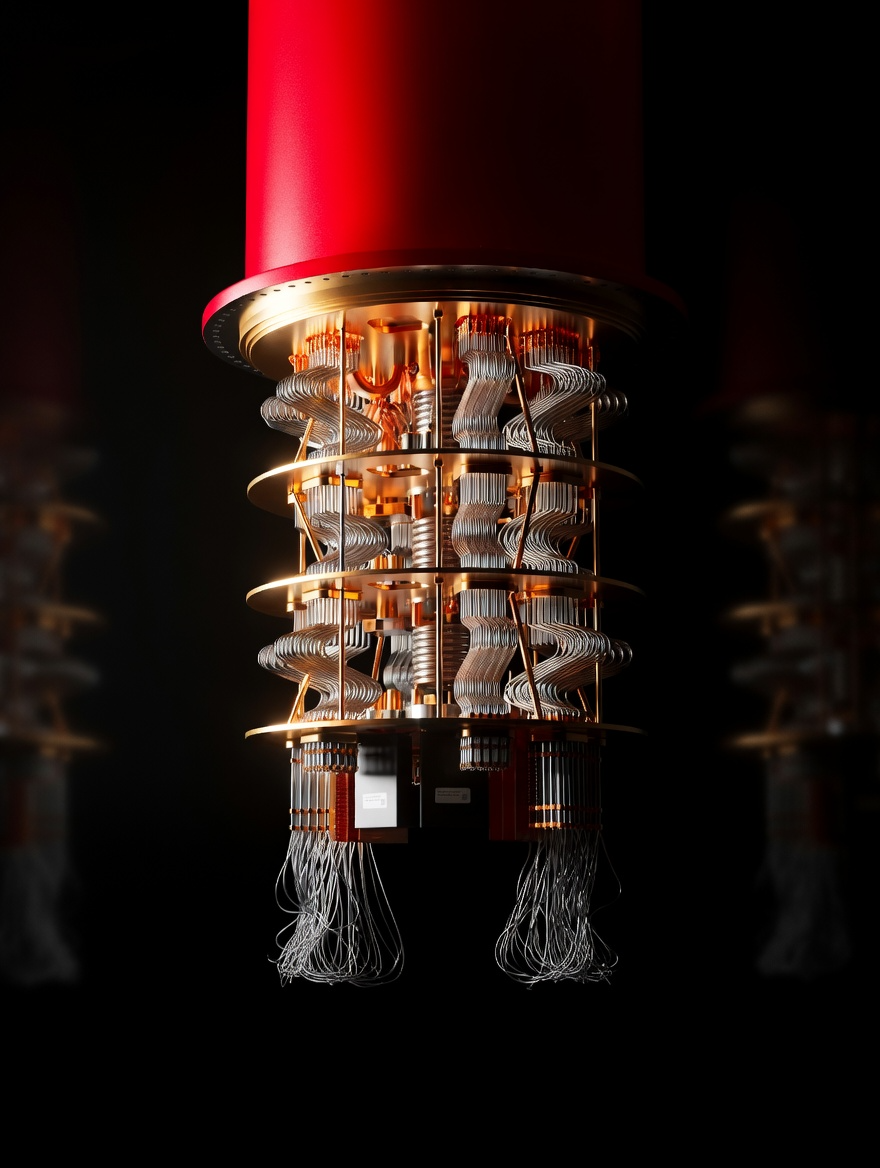
Quantum computers replace bits with qubits. Thanks to a quantum phenomenon called superposition, a qubit can exist as a 0, a 1, or both simultaneously — until you measure it. Pair that with entanglement (where the state of one qubit instantly influences another, regardless of distance), and quantum machines can explore a vast landscape of possible solutions to a problem at the same time, rather than working through them one by one.
To be clear: this does not make quantum computers faster versions of your MacBook. They are purpose-built tools, designed for specific classes of deeply complex problems — the kinds of problems that would take today’s most powerful supercomputers thousands of years to solve.
"The narrative has shifted from revolutionary hype to something far more valuable: steady, honest, verifiable progress."
The Era of “Quantum Utility” Has Begun
The field is currently in what researchers call the Noisy Intermediate-Scale Quantum era — NISQ, for short. These systems are still imperfect. Qubits are fragile; they lose their quantum state through a process called decoherence, and errors accumulate quickly. The machines exist, but getting reliable output from them remains a genuine engineering challenge.
Yet within those constraints, something important is happening: scientists are achieving what they call quantum utility — the point at which a quantum computer provides a demonstrable advantage over classical systems for a specific, real problem. It’s not general-purpose computing. It’s not replacing anything familiar. But it is, unmistakably, working.
Research era→ NISQ systems→ Quantum utility→ Fault-tolerant
Where the Impact Is Being Felt
Five domains are seeing the earliest and most credible signs of quantum advantage. None of them will show up in your daily life tomorrow. But all of them are laying groundwork that will matter enormously within a decade.
- Drug Discovery
- Logistics & Optimization
- Routing fleets, balancing energy grids, and reducing supply chain waste at impossible scale.
- Financial Modeling
- Risk simulations and Monte Carlo modeling at speeds classical hardware can’t approach.
- AI Enhancement
- Quantum processors working alongside GPUs to optimize neural networks and pattern recognition.
- Cybersecurity
Post-quantum cryptography is being built now, ahead of the systems that may one day break current encryption.
Drug Discovery: The Most Compelling Case
Of all the domains, drug discovery may carry the clearest argument for quantum investment. Molecules are, at their core, quantum systems. When a classical computer tries to simulate how a protein folds or how a potential drug binds to a receptor, it’s using approximations — educated guesses based on known chemistry. Those approximations are often good enough. But sometimes they’re not, and we don’t always know when they’ve failed us.
A quantum computer doesn’t need to approximate. It simulates the quantum behavior of molecules using the same physics that governs those molecules. Even modest improvements in simulation accuracy could mean the difference between identifying a viable drug candidate in two years versus eight. The downstream effects — on development costs, on patient access, on how quickly new treatments reach clinical trials — could be transformative.
The Security Question Nobody Is Waiting On
Here’s the one area where the timeline pressure is real, and where waiting is not an option. Current encryption standards — the mathematical locks that protect everything from online banking to government communications — were designed for a world where certain computations were effectively impossible. A sufficiently powerful quantum computer could, in theory, break those locks.
That machine doesn’t exist yet. But governments and major institutions are not waiting for it to arrive. The transition toward post-quantum cryptography — encryption standards that remain secure against quantum attacks — is already underway. The U.S. National Institute of Standards and Technology finalized its first set of post-quantum cryptographic standards in 2024, and adoption is accelerating globally. This is not panic. It’s responsible preparation, and it’s the right call.
What This Means for the Rest of Us
For most people, the immediate impact of quantum computing will be indirect. You won’t buy a quantum computer. You won’t notice when one is used to optimize the shipping route that got your package to your door faster, or when quantum simulation contributed to the design of the battery in your next electric car.
But that invisibility is, in a sense, the point. The most transformative technologies tend to disappear into infrastructure. Electricity, semiconductors, the internet — none of them remained novelties. They became the invisible substrate of daily life. Quantum computing may be on a similar trajectory, arriving not as a dramatic rupture but as a steady deepening of what we can compute, discover, and secure.
Key Takeaway
Quantum computing is no longer a theoretical future — it’s an engineering present. The machines are imperfect and specialized, but they are working. The narrative has shifted from “when will this be real” to “how do we scale what’s already real.” That is a genuinely significant transition, and it is happening now.
The honest truth about transformative technologies is that they rarely arrive on the schedule the hype cycle suggests. They take longer, require more unglamorous engineering work, and tend to reshape industries quietly rather than overnight. Quantum computing is proving to be exactly that kind of technology. Which means, for those paying attention, the time to understand it is now — before it disappears into the background, doing its extraordinary work invisibly.