
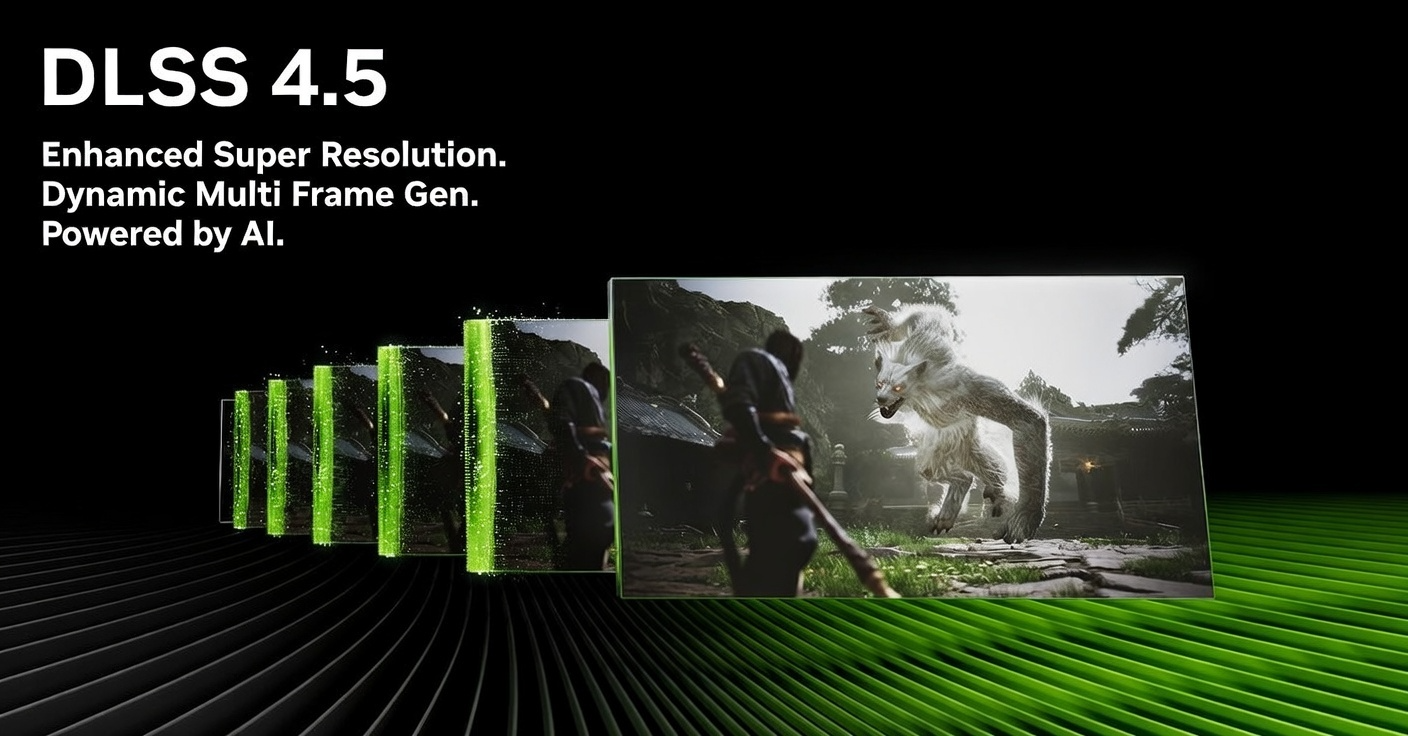
Las Vegas, January 5, 2026 — NVIDIA stole the show at CES 2026 with the announcement of DLSS 4.5, its most ambitious upgrade yet to the AI graphics technology that has already changed how we play games.
Building on years of steady progress, DLSS 4.5 combines a much-improved second-generation Transformer-based Super Resolution model with a clever new feature called Dynamic Multi Frame Generation. This isn’t just another small tweak — it represents a real shift in how games are rendered.
Instead of asking the GPU to do all the heavy lifting by rendering every single frame at full resolution, DLSS 4.5 lets advanced AI intelligently generate additional frames in real time.
NVIDIA claims this breakthrough can deliver performance gains of up to 6× in supported games. That means smooth 240+ FPS at 4K is now possible — even in the most demanding path-traced titles that used to bring high-end GPUs to their knees.
It’s a fundamental change in how performance is scaled: moving away from pure brute force toward smarter, AI-assisted efficiency.
What Makes DLSS 4.5 Stand Out
1. Second-Generation Transformer Super Resolution
NVIDIA has rebuilt its core AI model from the ground up. The new Transformer architecture brings clearer image reconstruction, sharper fine details, better motion clarity, and stronger temporal stability.
In practice, this means fewer annoying artifacts, less shimmering, and cleaner visuals overall — especially in fast-moving scenes or when looking at fine textures like hair, foliage, and distant objects.
The great news is that this upgrade works right away across a wide range of RTX GPUs — from the older 20-series and 30-series all the way to the latest 40-series and new 50-series cards.
All you need is a simple driver update. This wide compatibility means millions of existing users can immediately enjoy better image quality without buying new hardware.
2. Dynamic Multi Frame Generation (Up to 6× Performance)
This is the star of the show.
Unlike earlier frame generation that applied a fixed approach, the new Dynamic system analyzes each scene in real time. In heavy, graphically intense moments, it inserts more AI-generated frames to keep things smooth.
In lighter scenes, it relies more on traditionally rendered frames to protect image quality.
This smart balancing act helps avoid the inconsistencies and visual glitches that sometimes appeared in previous versions.
The full 6× mode is currently optimized for RTX 50-series GPUs, with wider support expected to arrive starting in Spring 2026.
3. Optimized for Path Tracing
DLSS 4.5 has been specially tuned for path-traced games.
This finally makes it practical for developers to use advanced lighting, realistic reflections, and complex global illumination without having to drastically cut settings or sacrifice playable frame rates.
Path tracing has long been considered the future of realistic graphics, but its heavy demands have held it back — until now.
Early Performance Impressions
In closed-door demos running on high-end RTX 5090 hardware, the results looked impressive.
Games like Cyberpunk 2077, Alan Wake 2, and Black Myth: Wukong reportedly jumped from struggling below 70 FPS in native 4K with full path tracing to well over 200 FPS with DLSS 4.5 enabled.
Early feedback from reviewers was positive:
- Image quality stayed stable and clean
- Ghosting was significantly reduced
- Input responsiveness felt noticeably better than earlier frame generation methods
Availability and Game Support
The improved Super Resolution features are rolling out immediately through the latest Game Ready drivers.
Dynamic Multi Frame Generation support will expand gradually throughout 2026.
Hundreds of existing DLSS titles will receive updates, and many major upcoming releases — especially those with heavy ray or path tracing — are expected to support DLSS 4.5 from day one.
Why This Matters
DLSS 4.5 shows a clear direction for the future of PC gaming. Instead of depending only on raw GPU power, NVIDIA is letting intelligent AI take on more of the workload. This means players can enjoy higher resolutions, richer visuals, and smoother performance without feeling pressured to upgrade their hardware every couple of years.
For the industry, it gives developers more freedom to push visual boundaries while keeping games playable.
By supporting older RTX cards alongside its newest hardware, NVIDIA is making these advances accessible to a much wider audience.
Final Perspective
If the real-world results match what we saw at CES 2026, DLSS 4.5 could quickly become one of the most important technologies for high-end gaming this year and beyond.
The future of gaming graphics isn’t just about faster hardware anymore — it’s increasingly about smarter AI working intelligently in the background to deliver the best possible experience.